
Flat commercial buildings were traditionally designed with roofing systems that prioritize short-term functionality over long-term adaptability. As these structures age, owners often face recurring issues related to durability, drainage efficiency, and rising maintenance demands.
At the same time, business operations today place a higher value on reliability, predictability, and asset protection than ever before. Retro-metal roof systems have emerged as a strategic response to these evolving expectations.
This article explores how these systems fit into flat commercial environments, why they are being considered more frequently, and what makes them relevant for long-term building planning.
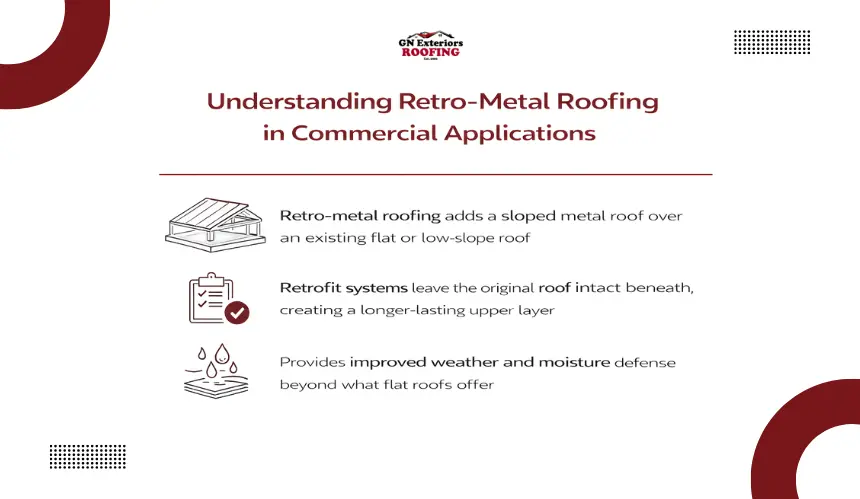
Retro-metal roofing refers to a retrofit system designed specifically for commercial buildings where an existing flat or low-slope roof remains in place. Instead of removing the original roof, a new structural framework is installed above it to support metal roof panels. This creates a separate, elevated roofing surface that takes over weather protection and long-term performance responsibilities.
Unlike traditional flat roof assemblies that rely on membranes or coatings, retro-metal systems introduce a metal-based solution that reduces exposure-related wear. By shifting water management and thermal performance away from the original roof surface, these systems address common limitations associated with aging flat commercial roofs.
Because the system enhances an existing structure rather than replacing it entirely, retro-metal roofing is classified as a retrofit solution. It is often considered during commercial reroofing discussions when building owners seek longer service life, reduced disruption, and a more predictable roofing strategy without a full tear-off.
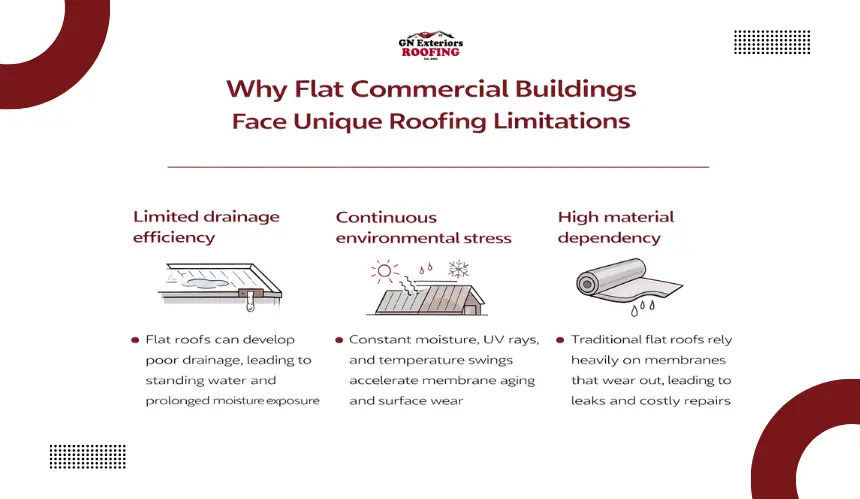
Flat commercial buildings offer practical advantages, but their roof design introduces challenges that compound over time. These limitations influence how roofs age, how often repairs are needed, and why conventional solutions struggle to deliver lasting performance.
Flat commercial roofs were not originally engineered to support sloped metal panels, which is why retro-metal systems rely on structural adaptation rather than direct replacement. Instead of altering the building’s core design, these systems work above the existing roof to resolve drainage, load, and performance limitations in a controlled and engineered way.
Retro-metal roof systems use a retrofit framing assembly to introduce slope above a flat roof surface. This added slope allows water to drain naturally, reducing reliance on internal drains or surface-level waterproofing. The original roof remains intact while the new metal roof becomes the primary system responsible for water management.
A key aspect of adaptation involves distributing weight safely across existing structural members. Retrofit framing is engineered to align with the building’s load capacity, ensuring the added metal roof system does not overstress the structure. This makes the solution suitable for many commercial buildings that cannot support heavier replacement assemblies.
By elevating the metal roof above the existing flat roof, retro-metal systems isolate performance from aging membranes or coatings below. Environmental exposure, thermal movement, and weather resistance are handled by the new metal roof, while the original roof is shielded from direct stress. This separation is what allows long-term performance improvements without structural modification.
Once structural compatibility is addressed, performance becomes the primary reason many building owners consider retro-metal roofing. These systems are designed to improve how a commercial roof functions over time, not just how it looks or how quickly it can be installed.
The benefits extend beyond surface protection and directly influence reliability, efficiency, and long-term planning.
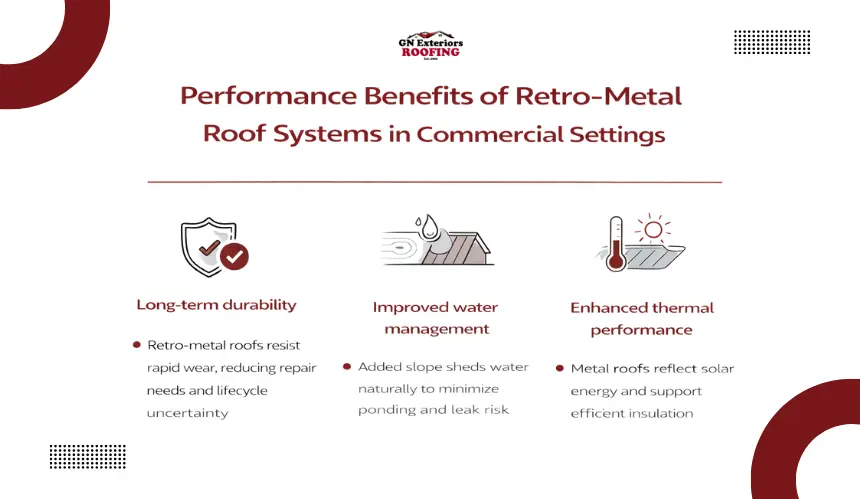
Retro-metal roof systems are built to withstand prolonged environmental exposure without the rapid material fatigue common in flat roof membranes. Metal panels resist cracking, splitting, and surface breakdown, which helps stabilize roof performance over decades. This durability reduces the cycle of recurring repairs that often disrupt budgeting and facility planning.
By introducing slope and elevating the primary roof surface, retro-metal systems allow water to shed naturally rather than remain on the roof. This significantly lowers the risk of ponding-related leaks and reduces stress on seams and penetrations. Consistent water movement improves overall roof reliability during heavy rain and seasonal weather changes.
Metal roofing systems reflect a portion of solar radiation while allowing for improved insulation strategies beneath the panels. This combination can help regulate interior temperatures more effectively than traditional flat roof assemblies. Over time, improved thermal performance supports energy efficiency goals and contributes to more stable indoor conditions.
Because the metal roof becomes the primary barrier against weather and exposure, maintenance requirements often decrease. Inspections focus on panel condition and fastening systems rather than widespread surface degradation. This shift allows maintenance efforts to become more predictable and less reactive, supporting long-term operational efficiency.
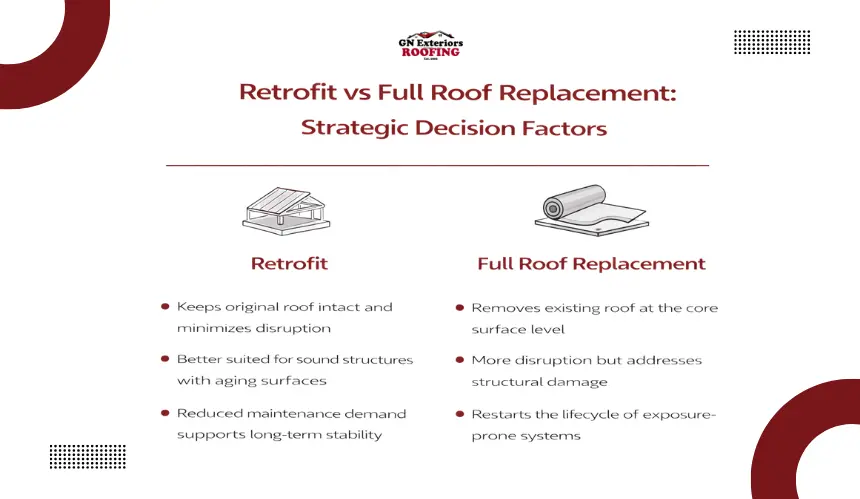
When a flat commercial roof reaches a point where repairs no longer provide reliable results, building owners are often faced with a critical decision. Choosing between a retrofit solution and a full roof replacement involves more than surface-level cost comparisons.
The right choice depends on how each option aligns with structural conditions, operational priorities, and long-term planning goals.
Retrofit solutions are typically considered when the existing roof structure remains sound, but the surface materials have reached the end of their functional life.
If structural components can support a retrofit framing system, retro-metal roofing allows owners to upgrade performance without removing the existing roof.
Full replacement becomes more relevant when structural damage, code compliance issues, or severe deterioration affect the building’s core support system.
One of the most significant differences between retrofit and replacement lies in disruption. Full tear-off projects often expose interiors, generate debris, and interrupt daily operations.
Retrofit metal roofing minimizes these impacts by keeping the existing roof in place, allowing many commercial facilities to remain occupied and functional throughout the installation process.
While full roof replacement may appear straightforward, it often restarts the lifecycle of systems that face the same exposure-related challenges over time. Retrofit metal roofing shifts the performance model by introducing a durable system designed for long-term stability.
For many commercial owners, this strategic shift offers greater predictability in maintenance planning, energy performance, and capital investment over the life of the building.
Understanding how a retro-metal roof system is installed helps clarify why it is often chosen for occupied commercial buildings. The process is structured to improve performance while limiting disruption, with each phase focused on working efficiently above the existing roof rather than dismantling it.
The process starts with a detailed evaluation of the existing roof and structural framework. Measurements, load calculations, and drainage planning are completed to ensure the building can support a retrofit system. This step establishes design parameters and confirms that the retrofit approach aligns with the building’s physical and operational requirements.
Once assessments are complete, a retrofit framing system is installed over the existing flat roof. This framework creates the necessary slope for water movement and provides attachment points for the metal roof panels. Because the original roof remains intact, interior spaces stay protected throughout this phase.
After framing is in place, metal roof panels are installed to form the new primary roofing surface. Panels are secured according to engineered specifications to manage wind forces, thermal movement, and long-term durability. At this stage, the retro-metal system becomes the building’s main defense against weather exposure.
The final phase includes flashing, edge detailing, and integration around penetrations or rooftop equipment. These details ensure continuity across the roof system and complete the transition from the original flat roof to the elevated metal assembly.
Once finished, the building benefits from a fully functional roofing system without the disruption associated with full roof replacement.
Cost is often the final factor that determines whether a roofing strategy moves forward. For retro-metal roof systems, the financial discussion goes beyond upfront expense and focuses more on long-term return, operational stability, and risk reduction.
Pricing is shaped by several variables, including building size, structural complexity, retrofit framing requirements, and panel selection. Because the existing roof remains in place, costs associated with tear-off, disposal, and interior protection are significantly reduced. Engineering, design coordination, and system customization also factor into the overall investment.
Retro-metal systems are designed to lower ongoing expenses rather than minimize first cost alone. Reduced maintenance demands, fewer leak-related repairs, and improved thermal performance contribute to measurable savings over the roof’s service life. These efficiencies help stabilize annual operating budgets and reduce unexpected capital expenditures.
Return on investment is best measured through lifecycle performance rather than short-term payback. Retro-metal roofing provides value by extending roof longevity, improving reliability, and minimizing business disruption tied to repairs or replacement.
For many commercial buildings, this predictable performance profile delivers stronger long-term financial outcomes than repeating traditional flat roof replacements.
Deciding whether to move forward with a retro-metal roof system requires a clear evaluation of building conditions, operational priorities, and long-term goals.
This decision is most effective when approached methodically rather than reactively, especially for commercial properties with ongoing occupancy or critical operations.
If the existing flat roof shows widespread surface wear but the structural components remain stable, a retrofit solution is often a viable option. Buildings with recurring leaks, aging membranes, or declining performance may benefit from shifting to a system that no longer depends on surface-level waterproofing as its primary defense.
Facilities that cannot afford prolonged downtime, interior exposure, or major disruption often align well with retrofit solutions. Retro-metal systems allow roofing upgrades to proceed while normal business activities continue, reducing risk to operations, inventory, and occupants.
If the priority is predictable performance, extended service life, and reduced maintenance uncertainty, a retro-metal roof system may align well with long-term facility strategies.
Buildings focused on short-term cost reduction or scheduled redevelopment may find alternative solutions more appropriate.
Final decisions should be supported by structural evaluation and professional guidance. Engineering review and system-specific analysis help confirm compatibility and prevent misalignment between roofing choice and building conditions, ensuring the selected approach supports both immediate needs and future planning.
If your commercial roof is approaching a critical decision point, GN Exteriors is ready to help you move forward with clarity and confidence. Their team specializes in evaluating roofing challenges, identifying practical retrofit opportunities, and guiding building owners toward solutions that support long-term performance and business continuity.
Retro-metal roof systems must comply with local building codes related to wind uplift, snow loads, fire ratings, and structural safety. Permitting requirements vary by jurisdiction and often require engineered drawings and inspections. Proper code alignment ensures the system is approved, insurable, and suitable for long-term commercial occupancy.
In many cases, retro-metal systems are designed to work around existing rooftop equipment such as HVAC units, vents, and skylights. Custom flashing and detailing allow these components to remain in place without relocation. This adaptability helps avoid added costs while maintaining system performance and accessibility.
Installation timelines vary based on building size, roof complexity, and weather conditions. For most mid-sized commercial buildings, retro-metal roof installations typically range from 2 to 6 weeks from initial setup to final detailing.
Smaller or less complex buildings may fall closer to the lower end of this range, while larger facilities with extensive rooftop equipment or custom framing can take longer. Because tear-off is avoided, work progresses in defined phases, allowing commercial operations to continue with minimal interruption throughout the project.
Modern commercial metal roof systems are engineered with insulation layers and structural separation that help control sound transmission. When properly designed, interior noise levels during rain or storms are often comparable to traditional roofing systems, even in large commercial or industrial spaces.
Retro-metal roofing warranties often cover metal panels, protective coatings, and installation workmanship. Coverage terms vary by system and manufacturer, but warranties are typically structured to support long service life expectations. Understanding warranty scope helps building owners plan maintenance and protect their investment over time.