

Commercial metal roofs are often viewed as long-term, low-maintenance assets, but their performance depends heavily on how well they are monitored over time. For facility managers and property owners, the challenge is not whether maintenance is necessary, but how to approach it in a way that prevents disruption and protects capital investment.
Unlike residential roofing, commercial metal roofing systems are exposed to larger surface areas, higher thermal movement, and constant operational stress. This guide focuses on a practical, step-by-step framework for maintaining commercial metal roofs.
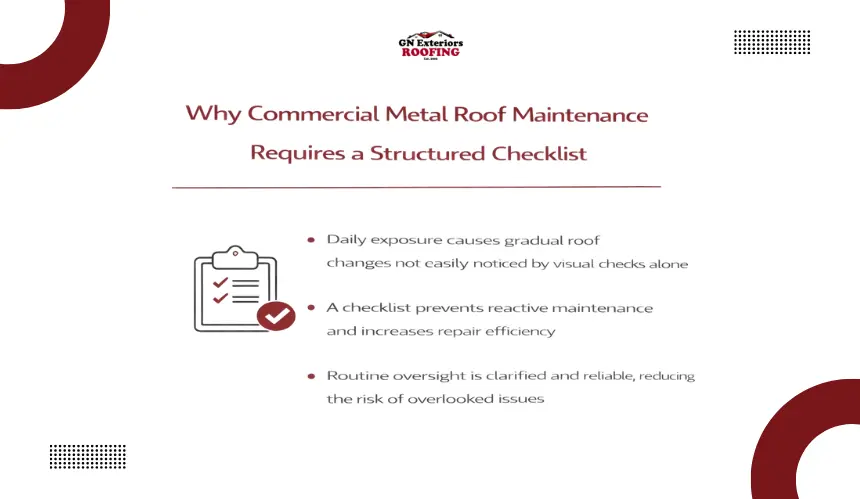
Commercial metal roofs are designed for durability, but they are not maintenance-free. Daily exposure to temperature shifts, wind loads, and operational vibration causes gradual changes that are easy to overlook without a defined process. A structured checklist provides clarity, ensuring routine oversight does not depend on memory or visual cues alone.
Without a checklist, maintenance often becomes reactive, driven by visible leaks or interior disruption rather than early indicators. This approach increases repair complexity and cost, while also introducing avoidable downtime. Consistent tracking allows facilities teams to identify concerns while they remain manageable.
A checklist tailored specifically to commercial metal roofing creates alignment between system design and maintenance strategy. It helps facilities maintain control over risk, budget planning, and roof performance without unnecessary inspections or redundant effort.
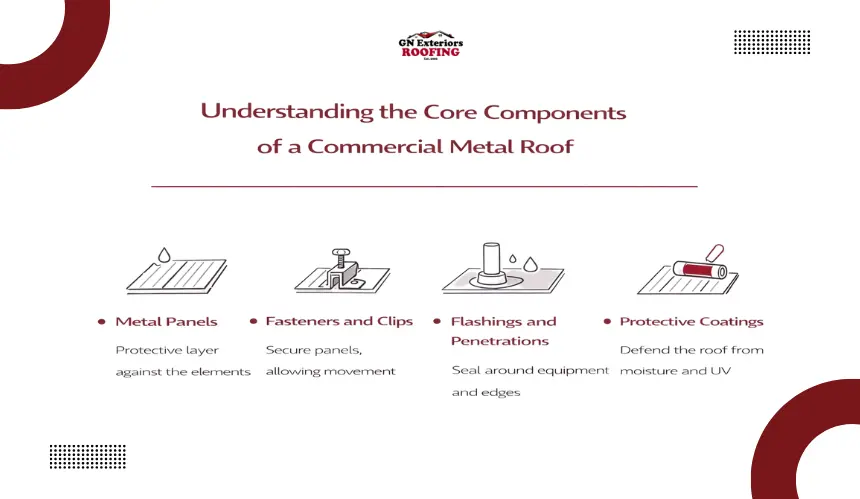
Commercial metal roofs are not a single-layer assembly. They are engineered systems designed to manage movement, water flow, and environmental exposure across large surface areas.
Knowing where responsibilities begin and end for each component prevents misdiagnosis and reduces the risk of overlooking critical failure points.
Metal panels form the primary protective layer of the roof and are designed to withstand prolonged exposure to sun, wind, and precipitation. Their profile, thickness, and finish influence how the roof responds to thermal expansion and surface wear.
Surface condition directly affects reflectivity, corrosion resistance, and overall durability, making panels a foundational focus in any maintenance strategy.
From an inspection standpoint, panels provide early visual indicators of system stress. Subtle changes in alignment or surface condition often signal underlying movement or environmental fatigue rather than isolated cosmetic issues.
Fasteners and clips secure the metal panels to the underlying structure while allowing controlled movement as temperatures change. These components absorb mechanical stress created by expansion, contraction, and wind uplift. Their performance determines whether the roof remains stable or begins to shift over time.
Because attachment systems operate under constant tension, even minor changes can affect overall roof integrity. Understanding how these elements function helps facility teams recognize when movement is expected versus when it indicates developing risk.
Flashings and penetration details seal areas where the roof surface is interrupted by equipment, walls, or changes in elevation. These points accommodate movement while maintaining watertight transitions. Their design and installation quality directly influence leak resistance.
In commercial environments, penetrations often increase over time as facilities expand or systems are upgraded. Recognizing these areas as engineered transition zones, rather than static seals, is essential for proper long-term maintenance planning.
Protective coatings serve as the roof’s first line of defense against UV exposure, moisture, and chemical contaminants. They enhance energy performance while slowing surface degradation. Over time, coatings experience gradual wear that affects both appearance and performance.
Understanding the purpose of these finishes helps facilities teams distinguish between normal aging and conditions that may compromise the roof’s protective capabilities. This awareness supports timely decisions without unnecessary intervention.
In Massachusetts, seasonal shifts create additional considerations. Temperature swings between winter and summer cause repeated expansion and contraction, especially in communities such as Quincy, Weymouth, and Hingham, where coastal winds and moisture levels are higher.
These environmental factors accelerate wear patterns that may not be as pronounced in more stable climates, making inspection timing just as important as inspection quality.
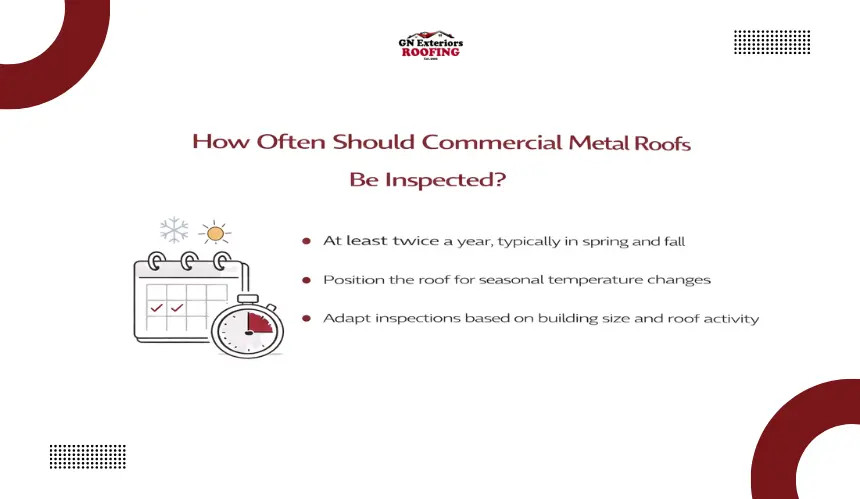
Most commercial metal roofs benefit from inspections conducted at least twice a year, typically in spring and fall. Spring inspections help identify stress or movement caused by snow loads and freeze-thaw cycles common across areas like Milton and Randolph.
Fall inspections prepare the roof system for colder temperatures, ensuring components are positioned correctly before thermal contraction increases.
Facilities located closer to the coast, including Dorchester and Hanover, often experience higher humidity and wind exposure. In these areas, scheduling inspections around seasonal transitions helps identify early signs of moisture-related wear without overlapping routine maintenance activities.
The way a facility operates also influences how often inspections should occur. Larger commercial roofs or buildings with rooftop equipment tend to experience more foot traffic and vibration.
This is common in industrial and mixed-use facilities throughout Greater Boston and surrounding towns. Increased access points and equipment movement raise the likelihood of subtle shifts that benefit from more frequent observation.
Rather than following a fixed calendar alone, inspection frequency should reflect both environmental exposure and operational demands.
This approach allows facility managers to maintain control over roof performance while avoiding unnecessary inspections that add little value.
Important: For coastal-facing building stock near Quincy, MA, inspection scheduling is not just about ‘today’s weather.’ NOAA’s Boston tide station shows a relative sea level trend of 2.97 mm per year (1921–2024), which gradually raises the baseline for coastal exposure over the long run. |
Before any inspection begins, safety and access planning determine whether the process is controlled or exposes the facility to unnecessary risk. Commercial metal roofs present unique challenges due to height, surface slickness, and unrestricted thermal movement.
Establishing clear safety protocols ensures inspections remain effective without interrupting operations or putting personnel at risk.
Safe roof access starts with identifying approved entry points and verifying their condition. Ladders, hatches, and perimeter access areas must support repeated use without shifting or obstruction. Commercial metal roofs can become slippery due to condensation, debris, or surface coatings, increasing fall risk if access is not controlled.
Fall protection planning should align with established workplace safety standards, including guidance from OSHA. Harness systems, anchor points, and edge awareness procedures help ensure inspections are conducted without exposing personnel to avoidable hazards.
Clear documentation prevents confusion during inspections. Facility teams should define the inspection scope in advance, outlining which roof sections will be accessed and what conditions are being evaluated. This preparation avoids unnecessary movement across sensitive areas and keeps inspections efficient.
Standards-based planning, such as referencing frameworks from ANSI, helps ensure inspection procedures are consistent and repeatable.
When safety planning and scope definition are aligned, inspections remain controlled, compliant, and focused on meaningful evaluation rather than reactive decision-making.
A visual surface inspection focuses on what can be identified without tools or disassembly. This stage is designed to catch early, surface-level indicators that suggest how the roof is responding to environmental exposure and structural movement. For facility teams, it provides a fast but meaningful snapshot of roof health before deeper evaluation begins.
In Massachusetts, fluctuating temperatures combined with coastal moisture exposure make surface observation especially important. Commercial buildings in areas such as Quincy and Weymouth often experience faster surface wear due to salt-laden air and wind-driven moisture, making subtle visual changes more meaningful than they might appear in more stable climates.
Metal roof panels are engineered to sit uniformly across the roof plane while allowing controlled movement. Visual misalignment, rippling, or subtle distortion can indicate stress from thermal expansion or uneven load distribution. These changes are not always structural failures, but they often signal areas that warrant closer monitoring.
On larger commercial buildings, especially warehouses or manufacturing facilities common throughout Greater Boston, minor panel shifts can occur gradually. Identifying these patterns early helps facilities teams distinguish between normal movement and conditions that may escalate if ignored.
Surface oxidation and coating wear typically appear first as discoloration, dullness, or localized spotting. These changes often develop more quickly in environments with frequent moisture exposure or airborne contaminants. Coastal air near Dorchester or Hanover, for example, can accelerate surface wear even when the roof remains watertight.
Recognizing these early visual cues allows facility managers to address protective finish concerns before corrosion affects panel performance. This approach supports long-term durability without prematurely committing to repairs that are not yet necessary.
Leaves, dirt, and airborne debris tend to collect in panel valleys, near roof edges, or around rooftop equipment. While debris may seem minor, it can trap moisture against the metal surface and interfere with natural water flow. Over time, this contributes to localized wear and uneven aging.
Routine visual checks for surface obstructions help maintain consistent exposure across the roof. Keeping panels clear supports even weathering and reduces the likelihood of moisture-related surface issues developing unnoticed.
Fasteners and attachment systems are the structural link between the metal roof and the building itself. While these components are small compared to panels, they absorb constant stress from wind loads, vibration, and thermal movement.
Evaluating them separately from surface conditions is essential because attachment issues often develop quietly and progress without visible warning signs.
Fasteners are designed to secure panels while allowing limited movement as temperatures change. Over time, repeated expansion and contraction can cause subtle loosening or back-out, particularly in exposed fastener systems.
These changes may not be obvious from a distance but can often be identified through localized panel lift or uneven seating.
Early detection of movement helps prevent progressive stress on adjacent panels and seams. Addressing fastener issues at this stage supports overall roof stability without escalating into widespread corrective work.
Clips play a critical role in managing how panels respond to wind uplift and thermal forces. Properly functioning clips distribute loads evenly across the roof structure, reducing localized stress. When clips shift, deform, or lose alignment, load transfer becomes uneven, increasing the risk of panel distortion over time.
Evaluating the clip condition provides insight into how the roof system is responding to ongoing environmental pressure. This assessment helps facility teams understand whether movement remains within design expectations or signals an emerging imbalance.
Attachment points connect the roofing system to the underlying structure, making them critical to long-term performance. These interfaces experience both vertical and lateral forces, especially on large commercial spans. Changes at these points often indicate broader system movement rather than isolated component failure.
Reviewing attachment conditions allows facilities to confirm that the roof remains securely integrated with the building. This step ensures structural continuity and helps prevent minor attachment concerns from evolving into system-wide instability.
Metal roofing systems rely on seams and expansion joints to manage movement without compromising weather resistance. These elements are engineered to accommodate thermal expansion, contraction, and structural shift while maintaining continuous protection across the roof surface.
Evaluating seam integrity as a standalone step helps isolate movement-related risks from other maintenance concerns.
Standing seam locks secure adjacent panels while allowing longitudinal movement. Over time, environmental stress and repeated thermal cycling can place strain on these locking mechanisms. Subtle separation, irregular spacing, or uneven seam height may indicate that movement is no longer being evenly absorbed.
Monitoring seam lock performance helps facility teams identify areas where expansion stress is concentrating. Addressing these indicators early supports system balance without disrupting surrounding components.
Horizontal seams and transition joints connect roof sections where slope, elevation, or panel length changes. These areas experience complex movement patterns because they absorb forces from multiple directions. Minor shifts at these joints can signal broader system response rather than localized failure.
Evaluating these connections independently helps prevent misattributing joint movement to surface or fastener issues. This clarity improves decision-making when determining whether observation or corrective action is appropriate.
Expansion joints are intentional design features that prevent stress buildup across large roof spans. Their effectiveness depends on maintaining clear movement paths and proper alignment. Obstructions, compression, or restriction at these points can redirect stress to unintended areas.
Assessing expansion allowance ensures that the roof system continues to move as designed. This step protects seam performance, reduces fatigue on adjacent components, and supports long-term roof stability.
Flashings and penetration details are where the metal roof system adapts to change. These areas manage transitions between surfaces, elevations, and materials while preserving weather resistance. Because they interrupt the continuous panel field, they experience higher stress and require focused evaluation separate from seams or fasteners.
In commercial facilities, penetration points often increase over time as buildings evolve. New HVAC units, electrical runs, or venting systems introduce additional transition zones, each with its own movement and sealing requirements.
Did you know? Along South Shore coastal communities such as Hingham, MA, it is worth remembering how extreme coastal water levels can get. The NOAA Boston tide gage recorded a 9.66 ft peak total water level during the January 2018 nor’easter, which is exactly the type of event that tests edge details and flashing assemblies. |
Penetrations created for mechanical and utility systems must accommodate vibration, thermal movement, and routine servicing. Flashing assemblies around these elements are designed to flex while maintaining a watertight barrier.
Changes in seal shape, material fatigue, or visible gaps often indicate that movement is no longer being absorbed as intended.
Facilities with frequent rooftop equipment access, such as those in dense commercial corridors like Dorchester, tend to see faster wear at these points due to repeated foot traffic and equipment servicing.
Monitoring penetration flashings in these environments helps prevent small sealing issues from developing into interior exposure.
Where the roof meets vertical walls, parapets, or perimeter edges, flashing systems manage water flow and directional movement.
These transitions experience combined forces from wind pressure, structural movement, and temperature variation. Even minor misalignment can alter how water is directed away from the building envelope.
Evaluating these transition points independently helps confirm that flashing profiles remain properly seated and responsive to movement. This step ensures that water management remains effective without relying on surface drainage alone.
Flashing assemblies often incorporate multiple materials, including metal, sealants, and flexible membranes. Each material ages differently and responds uniquely to environmental exposure. Incompatibility or uneven aging can compromise performance even when individual components appear intact.
Assessing material interaction and seal condition helps facilities teams determine whether flashing systems are continuing to function as designed. This clarity supports timely intervention without unnecessary replacement of components that remain structurally sound.
Effective drainage allows a commercial metal roof to shed water quickly and consistently, preventing prolonged moisture contact that can accelerate system wear.
Water-related issues often develop gradually. Minor flow disruptions can go unnoticed while increasing load on panels and transition points.
Evaluating drainage performance as its own step helps facility teams identify conditions that may not present as leaks but still affect long-term roof behavior.
Important: In shoreline-adjacent areas like Dorchester, MA, water and wind exposure can behave differently than inland sites. For example, Boston Harbor’s mean tidal range is about 9.49 feet, which is a reminder that coastal moisture cycles can be intense even without a ‘major storm’ headline. |
Commercial metal roofs rely on defined drainage paths that guide water toward scuppers or internal drains. These components must remain clear and properly aligned to function as intended. Partial blockages, sediment buildup, or misalignment can slow water movement, increasing surface exposure time after rainfall.
Facilities in inland areas such as Milton and Randolph often experience debris accumulation from surrounding trees, especially during seasonal transitions. Monitoring drain efficiency in these settings helps prevent water retention issues that are unrelated to roof surface condition.
Flashing assemblies often incorporate multiple materials, including metal, sealants, and flexible membranes. Each material ages differently and responds uniquely to environmental exposure. Incompatibility or uneven aging can compromise performance even when individual components appear intact.
Assessing material interaction and seal condition helps facilities teams determine whether flashing systems are continuing to function as designed. This clarity supports timely intervention without unnecessary replacement of components that remain structurally sound.
Metal roofs are not designed to retain standing water. Ponding or slow-drying areas often indicate subtle slope issues, blocked drainage paths, or surface obstructions.
These conditions increase localized stress and can accelerate coating wear even in the absence of visible damage.
Identifying flow interruptions early allows facility teams to address drainage concerns before they affect adjacent roof components. Maintaining efficient water movement supports overall system balance and reduces unnecessary moisture exposure across the roof surface.
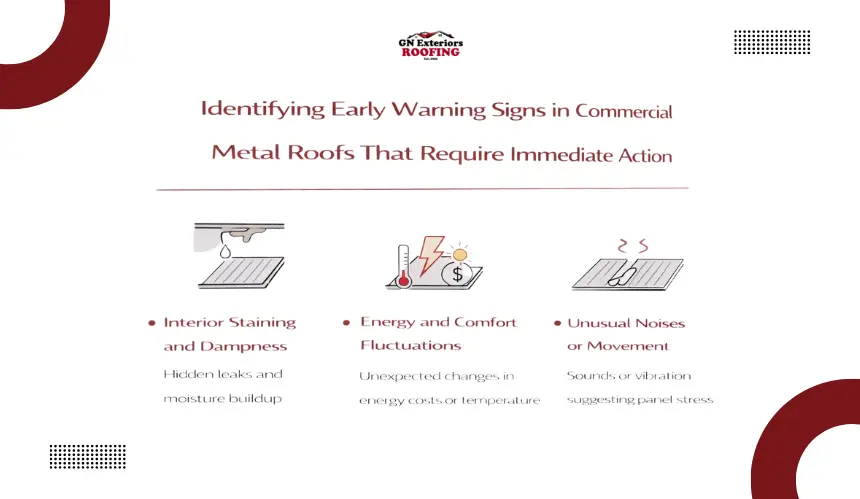
Some roof conditions signal more than gradual wear and should be treated as indicators that immediate attention is required. These warning signs often appear indirectly, affecting interior conditions or building performance rather than the roof surface itself.
Recognizing them early helps facility teams intervene before issues escalate into operational disruption or structural risk.
Changes inside the building frequently provide the first clues that the roof system is under strain. Staining on ceilings, damp insulation, or unexplained humidity shifts can indicate that water is entering or being retained within the roof assembly. These signs often appear before visible exterior damage develops.
Interior indicators are especially important because they reflect system performance rather than component condition alone. When these symptoms appear, they suggest that protective layers are no longer functioning as intended and require prompt evaluation.
Metal roofs play a role in thermal regulation and energy efficiency. Unexpected increases in heating or cooling demand can indicate compromised insulation, moisture intrusion, or surface performance changes.
These shifts are often gradual but become noticeable when energy usage patterns change without a clear operational cause.
Monitoring energy performance alongside roof condition provides an additional layer of insight. When comfort levels fluctuate unexpectedly, the roof system should be considered as part of the diagnostic process.
Unusual sounds such as popping, shifting, or vibration during temperature changes can indicate that movement is no longer being absorbed evenly. While metal roofs naturally respond to thermal cycles, abrupt or localized noises may suggest restricted expansion or uneven load distribution.
These signals are easy to dismiss but often point to developing stress within seams, attachment points, or transition areas. Treating them as early warnings allows facility teams to act before movement-related issues affect roof stability or weather resistance.
Maintenance activities only create long-term value when they are documented clearly and consistently. Without accurate records, facility teams lose visibility into past conditions, recurring patterns, and decision history.
Documentation turns individual inspections into a usable system that supports planning, accountability, and informed decision-making.
Inspection records should clearly identify dates, roof sections reviewed, observed conditions, and any changes from prior evaluations. Consistent formatting allows different team members to interpret findings without confusion.
This continuity is especially important for large facilities where inspections may be conducted by multiple personnel over time.
Well-structured records help track progression rather than isolated incidents. When changes are logged consistently, emerging trends become easier to recognize before they require urgent attention.
Photographic documentation adds context that written notes alone cannot provide. Images help validate observations, confirm location-specific conditions, and reduce misinterpretation during future reviews. They are particularly useful for monitoring gradual changes that are difficult to describe precisely.
Visual records also support communication between facility teams and external stakeholders. Clear imagery helps align understanding without requiring repeated site visits or reinspection.
Maintenance records become most valuable when they inform planning decisions. Historical data supports prioritization, allowing facilities to address recurring concerns strategically rather than reactively. This alignment helps balance maintenance timing with operational schedules and budget cycles.
When documentation is maintained consistently, it provides a defensible basis for decision-making. This transparency strengthens long-term planning, supports asset management goals, and reinforces proactive roof oversight without redundant inspections.
Protect your commercial investment and extend the life of your metal roof with expert guidance from GN Exteriors. Our team helps facilities in Massachusetts stay ahead of maintenance challenges, ensuring every inspection and repair is precise and proactive. Schedule your consultation today and keep your roof performing at its best year-round.
Yes. Many issues, such as localized coating wear, small seam gaps, or flashing failures, can be addressed with targeted repairs. Modern repair materials allow spot restoration, extending roof life and minimizing disruption without full panel replacement.
Warranties often require documented inspections and timely maintenance. Storm damage from high winds, heavy snow, or hail may only be covered if routine care is properly recorded. Keeping detailed maintenance logs ensures claims remain valid and prevents disputes.
High-quality reflective coatings significantly improve energy efficiency by lowering heat absorption on metal roof surfaces. In regions with seasonal temperature swings like Massachusetts, this can reduce HVAC demand, enhance occupant comfort, and contribute to sustainability goals.
Yes. Drone inspections allow safe evaluation of large or hard-to-access roofs, capturing high-resolution images of surface anomalies. Thermal imaging can reveal hidden moisture intrusion or insulation issues that might not be visible during visual inspections, enabling early corrective action.
Buildings close to the coast experience higher salt and moisture levels, which accelerate corrosion and coating wear. Proactive inspection schedules, specialized protective coatings, and attention to fasteners and flashing details are essential to maintain long-term roof performance.
Recent advancements include nanotechnology-enhanced coatings, modular fastener systems that reduce stress, and IoT-enabled monitoring for early detection of leaks or movement. These innovations allow facilities teams to predict problems and plan interventions more effectively.