

A Quick answer: Mechanical seam systems generally perform better than snap-lock systems when performance is measured by weather resistance, structural reliability, and long-term durability. Snap-lock systems perform well for simpler roof designs and moderate conditions, but mechanical seam systems offer higher tolerance, stronger seam compression, and more consistent performance under demanding environments. |
Choosing between snap-lock and mechanical seam standing seam systems is rarely about appearance alone. Most searchers want clarity on which system actually holds up better over time, especially when exposed to wind, moisture, temperature movement, and structural stress.
This article focuses on performance. It breaks down how each system functions, where each one excels, and why one may outperform the other depending on roof design, climate exposure, and long-term expectations.
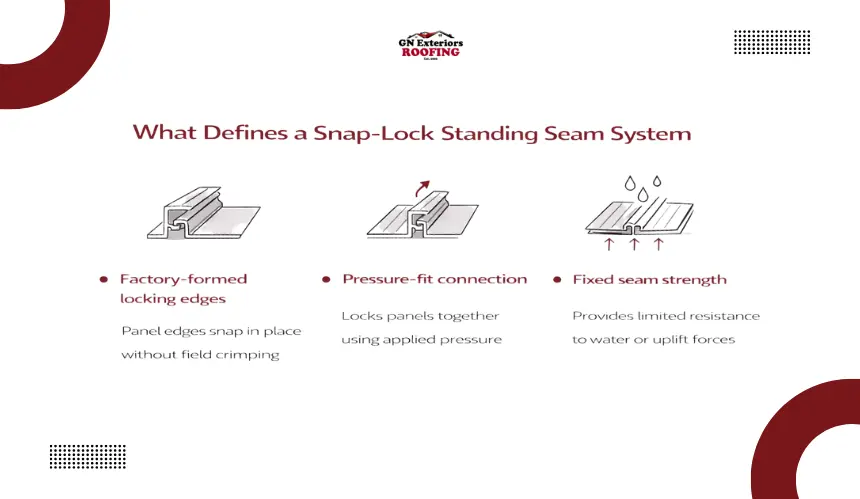
Snap-lock standing seam systems are often discussed as a simpler alternative within the standing seam category, but their performance characteristics are closely tied to how the seam itself is designed and formed. To understand how this system behaves on a roof, it is important to focus on the mechanics of the seam rather than installation speed or surface appearance.
A snap-lock standing seam system is built around factory-formed panel edges that are engineered to lock together through applied pressure rather than mechanical folding.
During installation, one panel leg snaps over the adjacent panel rib, creating a raised seam that holds panels in place without field crimping or seaming equipment.
The integrity of this connection depends heavily on manufacturing precision, panel alignment, and consistent engagement along the seam length.
Because the seam is not mechanically compressed after placement, the locking strength is fixed rather than adjustable. This means seam performance is largely predetermined by panel design and tolerances rather than installer-controlled reinforcement.
While this creates uniform seams and reduces variability during installation, it also limits how much additional resistance the seam can provide against uplift forces, water pressure, or structural movement over time.
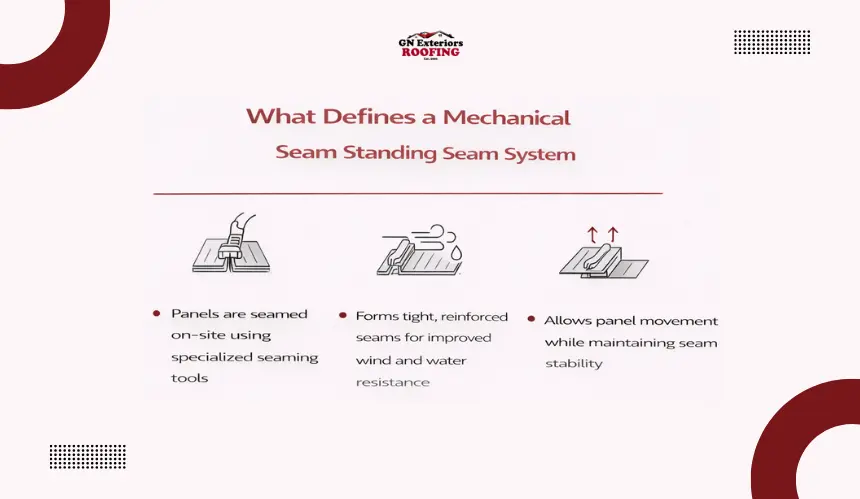
Mechanical seam systems are defined by how the seam is formed on the roof rather than in the factory. This distinction directly influences performance, especially in how the system responds to environmental stress, structural movement, and long-term exposure.
Understanding the mechanics behind this seam formation clarifies why these systems are often associated with higher performance thresholds.
A mechanical seam standing seam system uses flat or partially formed panels that are locked together on site using mechanical seaming tools. After panels are positioned, the seam is folded and compressed along its entire length, typically into a single-lock or double-lock configuration.
This process physically reshapes the metal, creating a tightly compressed seam that increases resistance to separation, uplift, and water intrusion.
Because the seam is formed in the field, installers can achieve consistent compression even across long panel runs or slight substrate variations. This ability to mechanically reinforce the seam after placement allows the system to compensate for minor alignment inconsistencies and job-site conditions.
The resulting seam is not dependent solely on factory tolerances, but on controlled mechanical force applied during installation.
Mechanical seam systems are designed to accommodate a wider range of structural conditions due to their ability to manage panel movement without compromising seam integrity.
The mechanically folded seam allows panels to expand and contract along their length while maintaining a secure lock, reducing stress on fasteners and attachment points as temperatures fluctuate.
This flexibility supports use across varied roof geometries, longer panel spans, and structures that experience higher structural movement. The seam’s reinforced profile provides added stability under load while still allowing controlled movement within the system.
As a result, mechanical seam systems maintain consistent performance even as building conditions change over time, which plays a significant role in their overall durability and reliability.
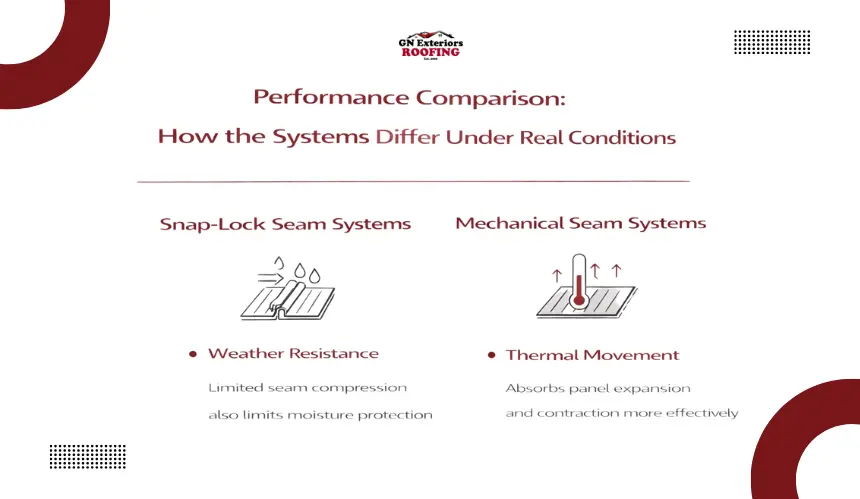
Once the seam structure is understood, performance differences become easier to evaluate. Snap-lock and mechanical seam systems respond very differently when exposed to real-world conditions such as heavy rain, wind pressure, temperature changes, and structural loading.
This section focuses strictly on how each system performs under stress, without revisiting design or installation mechanics already covered.
Weather resistance is largely determined by seam compression and continuity. Snap-lock systems rely on a pressure-fit connection that remains uniform but limited in tightness.
Under standard rainfall and normal wind conditions, this connection performs reliably, especially on steeper slopes where water moves quickly off the roof surface. However, the seam does not actively resist water pressure beyond its initial locking strength.
Mechanical seam systems achieve higher resistance because the seam is folded and compressed along its entire length. This compression creates a denser barrier against wind-driven rain, standing water, and snow accumulation.
In conditions where water is pushed laterally or held against the seam, the mechanically formed lock maintains integrity more consistently, reducing the risk of moisture intrusion over time.
Metal roofing systems expands and contracts with temperature changes, and how a seam accommodates that movement directly affects long-term performance.
Snap-lock systems allow panel movement, but the seam connection has limited ability to absorb repeated expansion cycles without gradually losing holding tension. Over time, this can increase stress at connection points if movement exceeds design expectations.
Mechanical seam systems are better equipped to manage thermal movement because the folded seam maintains grip while allowing controlled sliding within the assembly.
The reinforced seam profile distributes movement more evenly along the panel length, reducing fatigue at fasteners and minimizing long-term distortion. This makes mechanical seams more stable in environments with frequent or extreme temperature fluctuations.
Installation quality plays a decisive role in how both snap-lock and mechanical seam systems perform over time. Even when materials are well-engineered, differences in seam formation methods create clear contrasts in how each system responds to installer accuracy, job-site conditions, and unavoidable construction variability.
Snap-lock systems are built around a simplified installation process that relies on aligning panels and engaging the snap connection. Because the seam locks into place without field seaming, the installer’s primary responsibility is maintaining straight panel runs and consistent spacing.
This reduces the number of active steps during installation, but it also means there is little opportunity to correct alignment issues once panels are engaged.
Mechanical seam systems require a more technical installation approach. Panels must be positioned accurately, then mechanically seamed using specialized equipment.
This process demands greater installer experience, as seam consistency depends on proper machine setup and controlled operation. While the learning curve is higher, the system allows skilled installers to fine-tune seam formation as the roof is assembled.
Installation errors affect snap-lock systems more directly because the seam strength is fixed at the moment of engagement. If panels are slightly misaligned or the substrate is uneven, the snap connection may not fully engage along the seam length.
Since the seam cannot be tightened or reshaped afterward, small installation issues can remain embedded in the system and influence long-term reliability.
Mechanical seam systems are more forgiving when minor installation inconsistencies occur. Because the seam is formed after panel placement, installers can correct small alignment variations during the seaming process.
This ability to apply uniform compression along the seam helps minimize the long-term impact of job-site imperfections, allowing the system to maintain consistent performance even when conditions are less than ideal.
Long-term roofing performance is shaped by how a system behaves years after installation, not just during its early service life. Maintenance requirements, inspection clarity, and expected lifespan all influence whether a system continues to perform as intended.
Snap-lock systems typically rely on periodic visual inspections that focus on seam alignment, panel engagement, and clip stability.
Since the seam is not mechanically reinforced after installation, maintenance attention is often directed toward early indicators of seam relaxation or panel shift rather than seam failure itself. When issues arise, corrective action usually involves panel-level adjustments rather than seam modification.
Mechanical seam systems generally require less active intervention over time. The mechanically folded seam forms a dense, reinforced connection that resists gradual loosening, which shifts maintenance efforts toward routine condition checks rather than corrective repairs.
Inspections often confirm seam continuity and overall panel behavior, with fewer instances where seam integrity becomes a maintenance concern.
The expected service life of a snap-lock standing seam system typically ranges from 30 to 40 years when installed correctly and used within appropriate design conditions. Long-term performance depends heavily on how well the original snap engagement maintains tension as the roof experiences repeated thermal movement and structural stress.
In stable environments, performance can remain consistent, but lifespan predictability decreases when movement exceeds design tolerances.
Mechanical seam systems are commonly associated with a 40 to 50+ year service life due to the reinforced nature of the folded seam. The mechanically locked profile distributes stress across multiple layers of metal, which slows fatigue and reduces the likelihood of progressive seam relaxation.
This structural stability allows mechanical seam systems to maintain reliable performance deeper into their lifecycle, particularly on larger or more demanding roof assemblies where long-term consistency is critical.
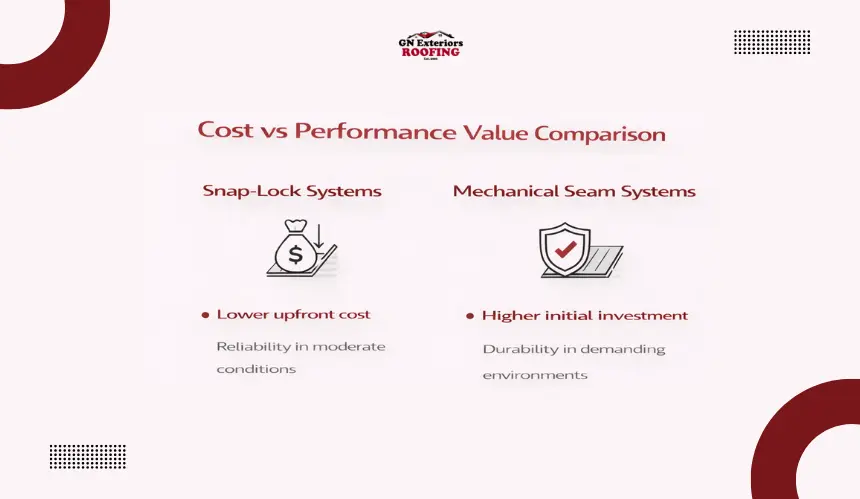
Cost is often one of the first factors considered when choosing a standing seam roofing system, but performance value extends well beyond initial pricing. This section focuses on how cost aligns with functional performance over time, rather than installation expense alone, to help clarify where each system delivers practical value.
Snap-lock systems typically carry a lower upfront cost due to reduced installation labor and simpler seam engagement. From a performance perspective, this investment aligns well with roofs that operate within moderate environmental and structural demands.
When design conditions remain within those limits, the system can deliver reliable service without requiring additional performance capacity that may never be used.
Mechanical seam systems generally involve higher initial costs, driven by specialized installation equipment and skilled labor requirements. That added investment translates into enhanced performance margins, particularly in how the system responds to sustained stress, movement, and environmental exposure.
Rather than paying for appearance or complexity, the cost reflects added structural capability and performance consistency.
Long-term value is determined by how consistently a roofing system performs without requiring corrective intervention. Snap-lock systems offer strong value when used in conditions that match their design profile, but performance margins are narrower, meaning unexpected stress can accelerate maintenance needs or shorten effective service life.
Mechanical seam systems provide higher long-term value in scenarios where performance demands are less predictable. Their reinforced seams and greater tolerance reduce the likelihood of performance degradation, which can lower the risk of premature repairs or system limitations.
When performance reliability over decades is prioritized, the higher initial cost is often offset by greater durability and fewer performance-related concerns over time.
Choosing between snap-lock and mechanical seam systems comes down to performance expectations, not guesswork. If you want clarity based on your roof’s design, exposure, and long-term goals, GN Exteriors can help evaluate what truly works best. A well-matched metal roofing system protects more than a structure. It protects peace of mind, year after year.
Snap-lock systems can be approved for higher wind areas if they meet specific testing standards and local code requirements. Approval usually depends on panel profile, clip spacing, and engineering documentation rather than seam type alone. Local building codes and uplift ratings should always be verified before selection.
Yes. Many jurisdictions require minimum slope thresholds for certain standing seam configurations. Snap-lock systems often have stricter slope requirements, while mechanical seam systems are more frequently approved for lower-slope applications due to their enhanced seam sealing capability.
In some cases, both systems may be installed over existing materials as part of a retrofit, but feasibility depends on structural capacity, ventilation design, and substrate condition. An engineering review is typically required to confirm load limits and attachment compatibility.
Warranty terms are influenced more by manufacturer specifications and installer certification than by seam type alone. Some manufacturers offer longer weathertight warranties for mechanically seamed systems because seam formation is controlled and verifiable during installation.
Noise perception is more closely related to insulation, decking type, and underlayment than seam design. With proper assembly, both snap-lock and mechanical seam metal roofs can achieve comparable acoustic performance, even during heavy rainfall.