
Key Takeaways
|
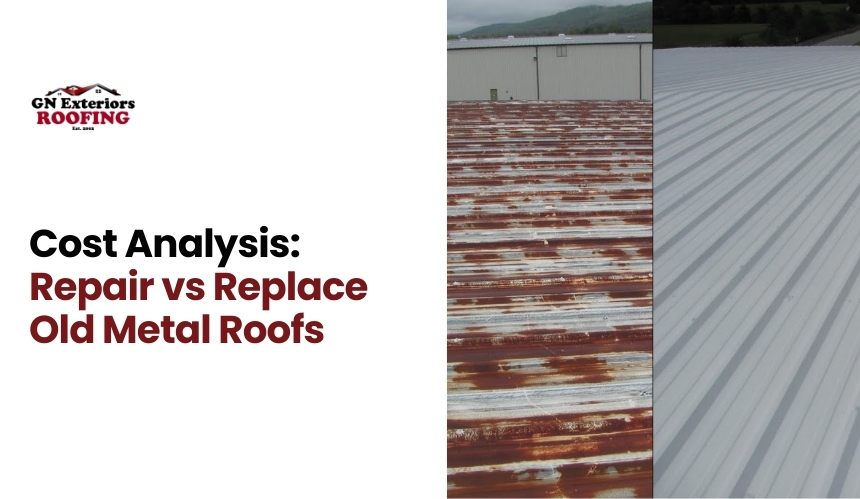
Repairing an old metal roof usually costs less upfront, but replacing it often delivers better value when repair expenses begin repeating or when the roof’s remaining lifespan is limited. The real cost difference is not just about today’s price tag, but about how long each option continues to perform without creating additional financial strain.
This article focuses on breaking down that cost comparison in a practical way. It looks at how repair costs accumulate, when replacement becomes more economical, and which factors actually influence long-term financial outcomes.
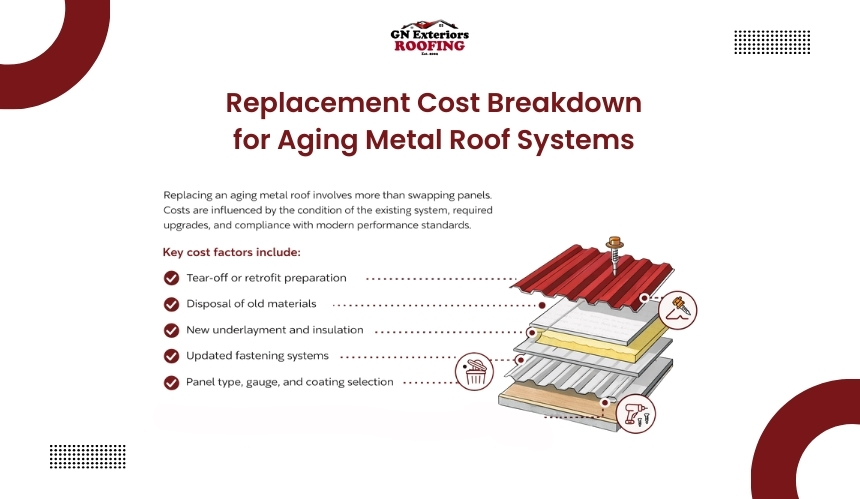
Replacing an old metal roof involves a broader scope of work than many property owners expect. Costs are not determined by panels alone, but by the condition of the existing system and the level of modernization required.
Replacement pricing reflects the removal or integration of the existing roof system and the installation of a fully functional new assembly.
Expenses often include tear-off or retrofit preparation, disposal of old materials, updated underlayment, improved insulation layers, and new fastening or attachment systems designed to meet current performance standards.
Panel selection also affects cost, as gauge thickness, coating type, and profile design influence both material pricing and installation time.
Labor remains a major component because replacement requires system-level accuracy. Crews must account for thermal movement, panel alignment, and water-shedding paths across the entire roof surface.
Compliance with current building codes, including wind uplift and snow load requirements where applicable, further contributes to overall cost.
The age of an existing metal roof directly affects how complex and costly replacement becomes. Older systems often conceal substrate deterioration, outdated fastener patterns, or incompatible panel designs that require corrective work before new materials can be installed.
Deck repairs, structural reinforcement, or removal of obsolete components can add unexpected layers of expense.
Roofs that have undergone multiple repair cycles may also present alignment issues or uneven surfaces that increase labor time. In these cases, replacement costs rise not because of size, but because restoring a stable foundation is essential for the new roof to perform as intended.
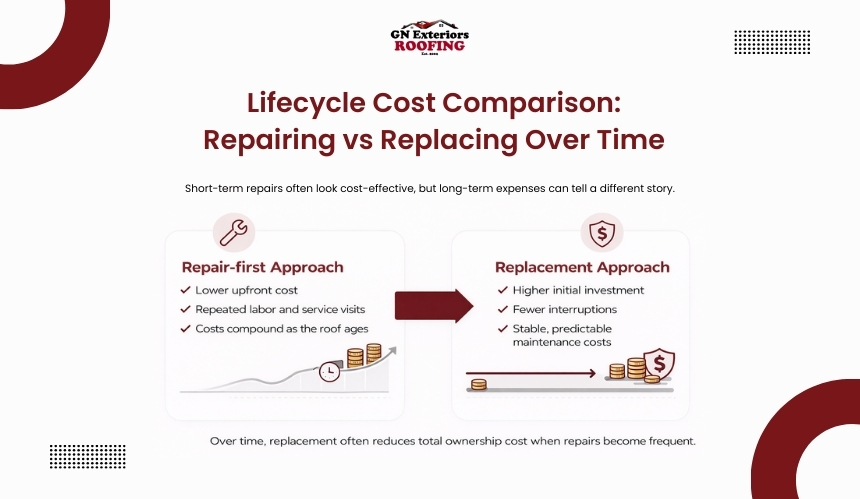
Looking at roofing costs through a lifecycle lens changes how repair and replacement decisions are evaluated. Instead of focusing on a single invoice, this section examines how expenses develop over years of ownership, revealing cost patterns that are not visible in short-term budgeting.
In the short term, repairs usually appear financially attractive because they address immediate problems with limited upfront expense. This approach works best when repairs are infrequent and resolve clearly defined issues.
Over time, however, repeated service calls, labor charges, and incremental fixes can accumulate into a substantial total cost that quietly rivals replacement pricing.
Replacement follows the opposite pattern. The initial investment is higher, but expenses tend to stabilize once the new system is installed. With fewer service interruptions and predictable maintenance needs, long-term costs often flatten.
From a lifecycle perspective, the decision hinges on whether repair spending remains linear or begins to compound as the roof continues to age.
Repair-focused strategies sometimes mask indirect expenses that surface gradually. Minor leaks that persist between repairs can affect insulation performance, interior finishes, or equipment below the roofline.
Energy efficiency may also decline as aging panels and compromised seals allow heat transfer and moisture intrusion to increase operating costs.
There is also the cost of uncertainty. Scheduling disruptions, emergency service premiums, and the risk of sudden failure introduce financial stress that is difficult to quantify but very real for property owners.
When these hidden costs become frequent, they often signal that repairs are no longer containing overall ownership expenses effectively.
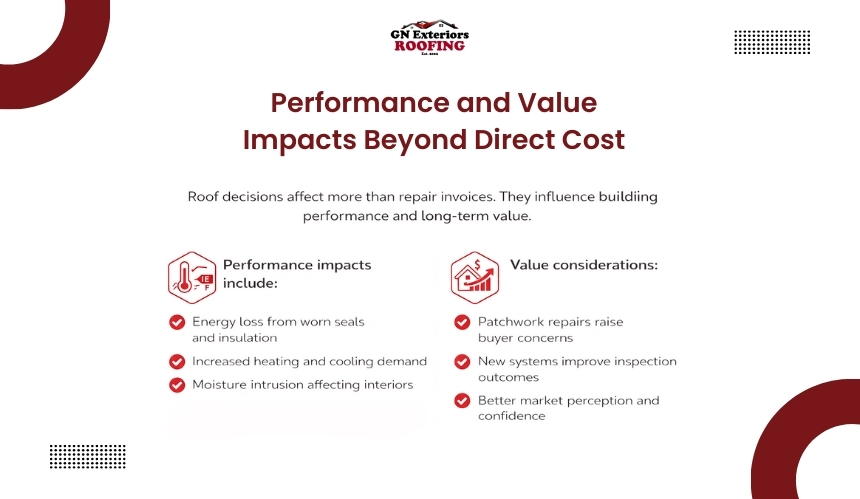
Cost comparisons often focus on invoices and timelines, but metal roof decisions also affect how a building performs and how it is perceived over time.
An aging metal roof can gradually lose its ability to regulate interior temperatures, even when visible damage seems minor. Gaps created by panel movement, worn sealants, or compressed insulation allow heat transfer and moisture intrusion that increase heating and cooling demand. As a result, utility costs may rise quietly, month after month, without a clear link to the roof itself.
A newly installed metal roof system often restores consistent thermal control by incorporating modern underlayment, improved insulation placement, and tighter sealing methods.
These improvements do not eliminate energy costs, but they stabilize them. For property owners, this predictability reduces seasonal cost spikes and supports a more comfortable interior environment, especially in buildings with large roof surface areas.
Roof condition plays a strong role in how a property is evaluated by buyers, inspectors, and insurers. An older metal roof with visible patchwork repairs can raise questions about remaining lifespan, even if it is currently watertight. These concerns often translate into lower offers, delayed transactions, or requests for concessions during negotiations.
In contrast, a recently replaced metal roof signals reliability and reduced near-term risk. Transferable warranties, uniform appearance, and documented installation standards can improve buyer confidence and simplify inspections.
While this value is not always reflected immediately in resale price, it often influences how smoothly a property moves through the market and how it is perceived compared to similar listings.
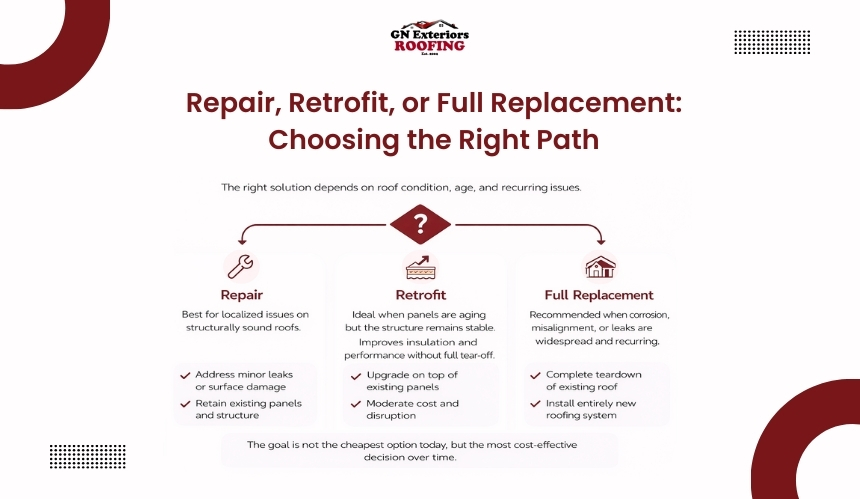
At this stage, the decision becomes less theoretical and more situational. In Massachusetts, roofing choices are shaped not only by roof condition but also by coastal exposure, winter freeze-thaw cycles, and local building expectations.
Repairs are typically the right choice when a metal roof is structurally sound and issues are limited in scope. In communities like Dorchester and Quincy, where many buildings are exposed to coastal winds and salt air, fastener loosening and localized seam leaks are common but not always signs of system failure.
When corrosion is minimal and leaks originate from identifiable points, targeted repairs can restore performance without escalating costs.
Local roofers report that minor metal roof repairs in the Boston area often range around $1,200 to $1,500 for typical fixes, such as sealing leaks or tightening fasteners, although costs vary with access and complexity.
This approach works best when repairs are infrequent and the roof still has meaningful service life remaining. It is less suitable once repairs become routine or spread across multiple areas after harsh winters.
Retrofit solutions sit between repair and full replacement and are often chosen when the original panels are aging but the underlying structure remains stable. In towns such as Hingham and Weymouth, older metal roofs frequently face recurring weather-related stress from heavy snowfall, ice dam formation, and strong coastal gusts.
A retrofit allows property owners to improve insulation, drainage performance, and fastening systems without a full tear-off.
In Massachusetts, retrofit systems for residential roofs often cost in the mid-range four-figure to lower five-figure range (often between about $10,000 and $25,000 total, depending on roof size and retrofit scope), balancing improved performance with moderate cost outlay. ‘
These solutions typically extend useful life substantially and improve thermal comfort and leakage resistance without the full disruption of a tear-off.
Full replacement is usually warranted when damage is widespread or systemic. In Hanover, Milton, and Randolph, frequent freezing and thawing cycles combined with snow load stresses can accelerate fatigue throughout the metal roof system.
When corrosion appears across multiple areas, panel alignment has shifted, or leaks repeatedly show up in new locations, repairs and retrofits may no longer contain total ownership costs.
For metal roof replacement in Massachusetts, industry pricing data shows that installed metal roofing usually runs between about $10 and $18 per square foot for a full system on a typical residential roof, with many homeowners paying in the range of $18,000 to $36,000 total for an average size roof (approximately 1,600–2,000 square feet).
If your metal roof is raising more questions than confidence, GN Exteriors is here to help you make a clear, cost-smart decision. As a local metal roofing company in Massachusetts with a strong understanding of how local weather impacts roofing systems, our team evaluates whether repair, retrofit, or full replacement truly makes financial sense.
A straightforward inspection today can save you from unnecessary costs tomorrow and give you real peace of mind moving forward.
In Massachusetts, metal roofs commonly last between 40 and 60 years, but real-world performance depends heavily on exposure. Coastal salt air, repeated freeze-thaw cycles, and snow load can reduce effective lifespan if detailing, fasteners, or coatings begin to fail earlier than expected.
With high-quality installation and consistent maintenance, some metal roof systems can remain functional well beyond standard lifespan expectations.
Insurance policies may cover storm-related damage to metal roofs, but coverage often decreases as a roof ages. Repeated claims or wear-related issues are frequently excluded, which can shift the financial balance toward replacement after significant weather events.
Yes. Massachusetts follows the 10th Edition State Building Code, based on the 2021 IBC and IRC, which includes stricter requirements for wind uplift, snow load, and energy efficiency.
Many older metal roofs were installed under earlier standards, so replacements often require upgraded attachment systems, insulation, or underlayment, increasing overall project cost even for similar-sized roofs.
Heavy snowfall places consistent stress on seams, fasteners, and panel movement points. Roofs that were not designed with proper snow-shedding or expansion control may experience accelerated fatigue, influencing whether ongoing maintenance remains viable.
Most metal roofing work is planned during milder seasons, but experienced contractors can manage installations year-round with proper staging. Weather timing affects labor efficiency and scheduling, which can influence overall project planning rather than roof quality itself.