Key Takeaways
|
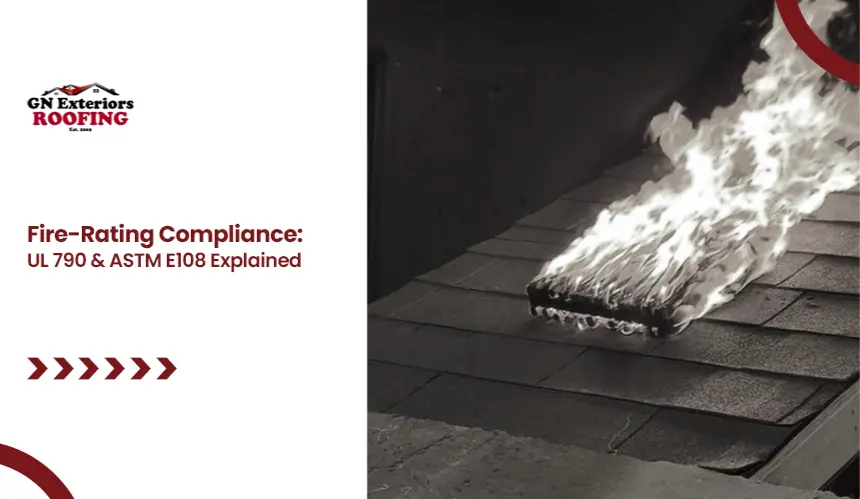
Fire-rating compliance plays a direct role in building safety, code approval, and insurance acceptance. When professionals search for UL 790 and ASTM E108, they are usually verifying whether a roofing system meets recognized fire performance requirements set by building regulations.
These standards, established by Underwriters Laboratories and ASTM International, define how roof assemblies are evaluated under fire exposure conditions. Understanding their purpose helps avoid approval delays, inspection issues, and compliance risks later in the project lifecycle.
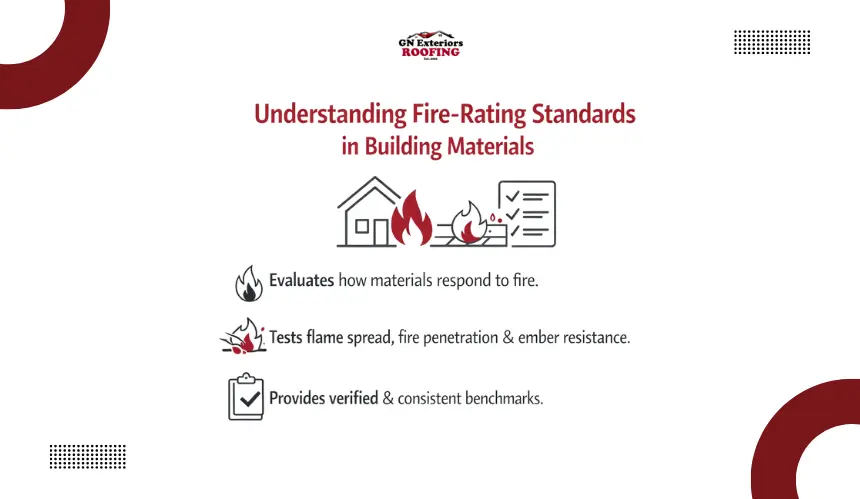
Fire-rating standards exist to create a consistent, measurable way to evaluate how building materials respond when exposed to fire. Without standardized testing, fire resistance would rely on assumptions rather than verified performance.
Fire ratings measure how roofing materials and complete roof assemblies behave under controlled fire exposure scenarios. The evaluation focuses on flame spread across the surface, resistance to fire penetration through the assembly, and the ability to withstand ignition caused by airborne embers. These factors reflect real-world fire risks, especially in areas prone to wind-driven flames or external fire sources.
Rather than judging appearance or material type, fire-rating tests examine performance under stress. This distinction is critical because two visually similar roofing products can perform very differently when exposed to heat, flame contact, or intermittent fire conditions.
Fire-rating standards translate these performance outcomes into classifications that building codes and inspectors can rely on for safety decisions.
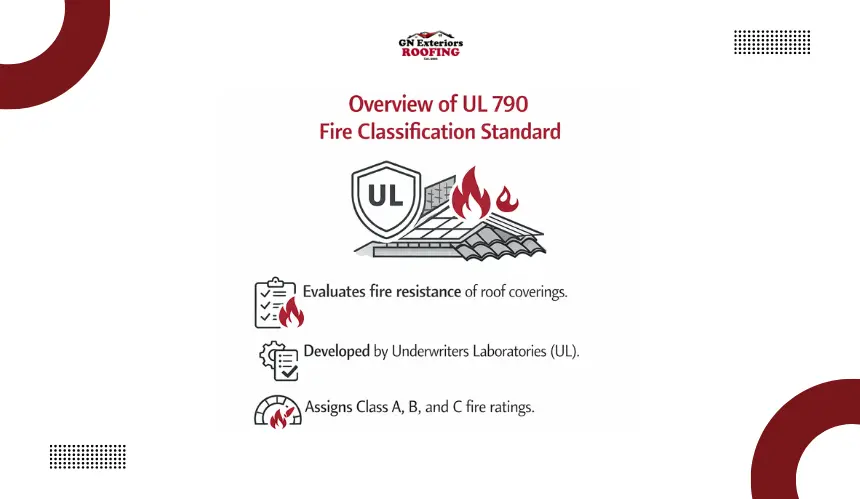
UL 790 is one of the most widely referenced fire classification standards for roofing systems in the United States. It is commonly cited in building codes, manufacturer specifications, and inspection reports because it provides a clear framework for evaluating how roof coverings perform when exposed to external fire sources.
UL 790 is a fire test standard created to assess the fire resistance of roof coverings under controlled exposure conditions. It was developed by Underwriters Laboratories to support consistent safety evaluation and third-party verification across the construction industry.
The goal is not to predict every fire scenario, but to establish repeatable benchmarks that indicate how roofing systems respond to flame contact and ignition sources.
Unlike general material testing, UL 790 evaluates roof coverings as installed systems. This approach reflects how fire actually interacts with roofs in real structures, where installation methods, substrates, and layering influence performance outcomes.
UL 790 assigns fire ratings based on the severity of fire exposure a roof system can withstand. Class A represents the highest level of fire resistance, indicating strong performance against severe flame exposure and ignition risk. Class B reflects moderate resistance, suitable for conditions with reduced fire intensity. Class C indicates basic protection under light fire exposure scenarios.
These classifications provide a standardized language that builders, inspectors, and code officials use to assess compliance. Rather than describing materials subjectively, UL 790 translates fire performance into clear categories that support approval decisions and safety planning.
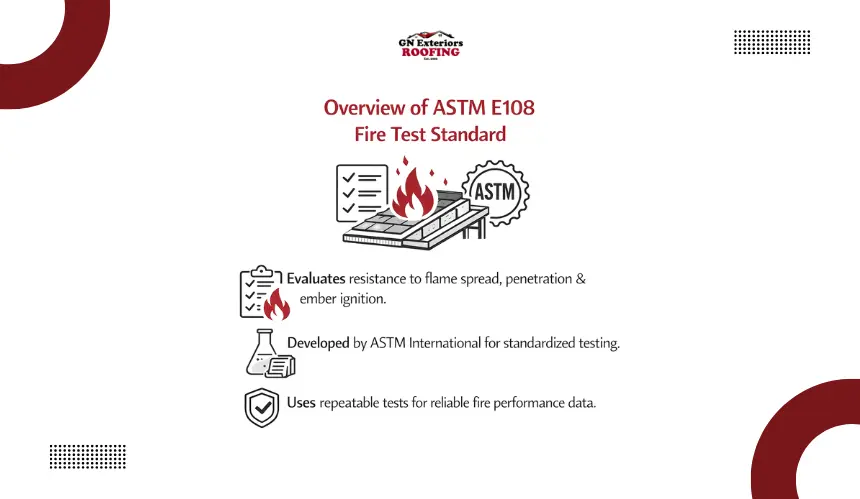
ASTM E108 is another core standard used to evaluate fire resistance in roofing systems. It is frequently referenced alongside UL 790 because it addresses similar fire exposure risks, while relying on a testing framework built around standardized procedures and repeatable results.
ASTM E108 is a fire test method designed to measure how roof coverings perform when exposed to external fire conditions. Developed by ASTM International, the standard emphasizes uniform testing protocols that allow consistent comparison across materials and roof systems.
Its primary purpose is to evaluate resistance to flame spread, fire penetration, and ignition from simulated fire sources.
The scope of ASTM E108 focuses on performance under controlled laboratory conditions rather than product branding or manufacturer claims.
This makes it a reliable reference for engineers, inspectors, and code officials who need objective fire performance data when reviewing roofing assemblies.
ASTM E108 assigns Class A, Class B, and Class C ratings based on how a roofing system performs during controlled fire exposure testing. Each class reflects a different level of protection and suitability depending on fire risk and code requirements.
These classifications convert detailed test results into clear compliance indicators, allowing building professionals to assess fire performance quickly without needing to interpret technical testing data.
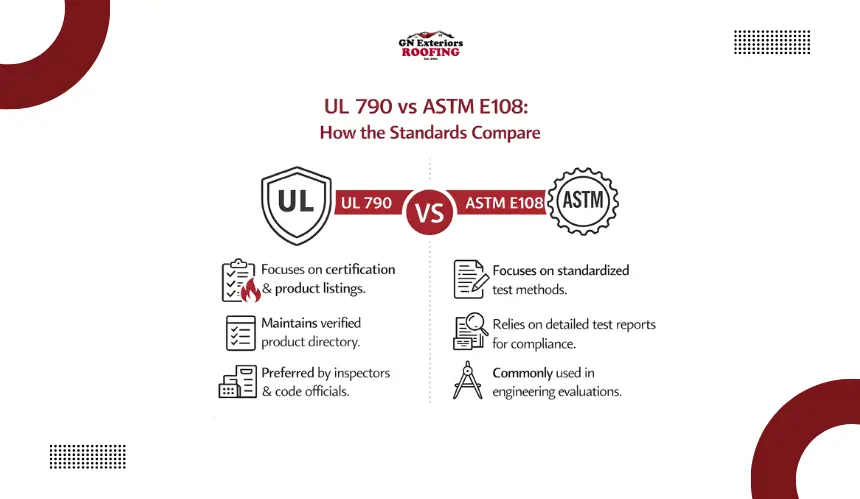
UL 790 and ASTM E108 are often referenced together because they address the same core concern: how roofing systems perform when exposed to external fire. While their outcomes may appear similar on the surface, they are built on different frameworks and are used slightly differently in compliance and approval processes.
Both standards evaluate roofing systems under controlled fire exposure conditions and classify performance using Class A, B, and C ratings. Each class reflects increasing resistance to flame spread, fire penetration, and ignition from external fire sources. Because of this alignment, building codes frequently recognize either standard as acceptable evidence of fire performance.
From a safety perspective, both UL 790 and ASTM E108 aim to reduce fire propagation risk at the roof level. This shared objective is why manufacturers often test systems under both standards to meet broader regulatory and market requirements.
The primary distinction lies in how results are produced and applied. UL 790 is closely associated with certification and listing, meaning compliant roof systems are often published as part of a verified product directory maintained by Underwriters Laboratories. This makes UL 790 especially useful for inspectors who rely on listings rather than individual test reports.
ASTM E108, developed by ASTM International, functions strictly as a standardized test method. Compliance is demonstrated through documented test results rather than ongoing product listings. As a result, ASTM E108 is commonly used in engineering evaluations, project submittals, and situations where performance data must be reviewed in detail.
Fire-rating compliance does not end with selecting a rated product. Verification happens through documentation, review, and approval steps that confirm a roofing system meets applicable fire performance requirements as installed.
Compliance is typically verified through formal documentation that proves a roofing system has been tested and evaluated under a recognized fire standard. UL 790 compliance is often demonstrated through active product listings maintained by Underwriters Laboratories, which allow inspectors to confirm approval without reviewing individual test data.
ASTM E108 compliance relies on detailed laboratory test reports that describe testing conditions, assembly configuration, and performance results. These reports are reviewed during plan submittals or inspections to confirm that the tested system matches the installed assembly.
Verification focuses on the full roof system rather than isolated materials, since installation methods and component layering directly affect fire performance.
Building codes define which fire standards are acceptable and how compliance must be demonstrated. Many jurisdictions reference fire ratings through documents such as the International Building Code, which recognizes UL 790 and ASTM E108 as valid fire test standards. Code requirements establish minimum fire classifications based on building type, occupancy, and location.
Final approval rests with the authority having jurisdiction, which may include local building departments or fire officials. These authorities review submitted documentation, confirm alignment with code requirements, and ensure that the installed roofing system matches the approved fire-rated configuration.
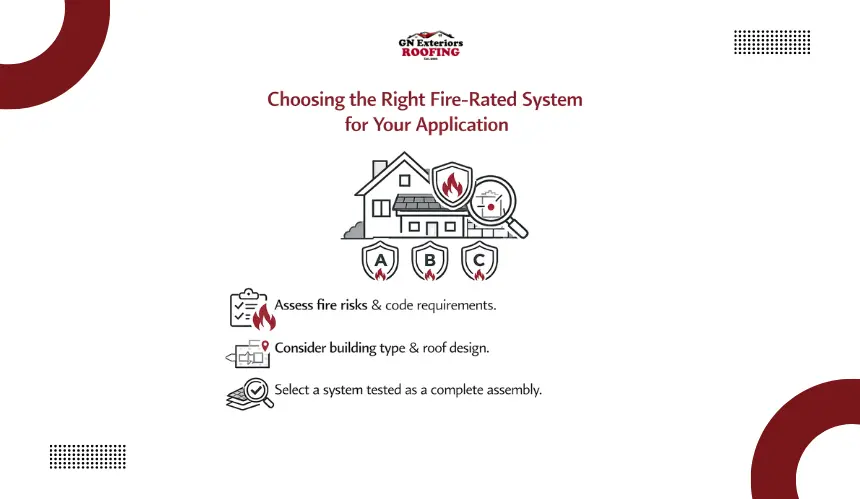
Selecting a fire-rated roofing system is a decision that should be guided by risk exposure, code requirements, and documented performance rather than assumptions or material labels. A clear evaluation process helps reduce compliance risk and supports smoother approvals.
Fire rating requirements are shaped by building use, roof design, and local fire exposure conditions. Steeper slopes, combustible substrates, and high-risk fire zones typically demand higher fire classifications. Insurance criteria and zoning regulations can also influence whether a Class A rating is required rather than a lower classification.
System compatibility matters as much as the rating itself. Fire performance is evaluated based on tested assemblies, meaning changes in underlayment, fastening methods, or insulation can affect compliance even when the surface material remains the same.
Fire-rating requirements in Massachusetts are often influenced by local building enforcement and neighborhood density. Projects in communities such as Dorchester, Hanover, Hingham, Milton, Quincy, Randolph, and Weymouth often require closer attention to Class A fire-rated assemblies due to proximity between structures and inspection scrutiny.
Choosing a fire-rated system that aligns with both state code and local enforcement practices helps reduce approval delays and minimizes the risk of corrective work after installation.
If fire-rating compliance feels overwhelming, working with the right team makes all the difference. GN Exteriors helps property owners and builders choose roofing systems that align with UL 790, ASTM E108, and local code expectations. As a trusted Metal Roofing Company in MA, the focus stays on verified assemblies, proper documentation, and smooth approvals from start to finish.
Yes. Many insurance providers review roof fire ratings when underwriting or renewing policies. Roof systems with higher fire classifications are often viewed as lower risk, which can influence eligibility, premiums, or coverage terms, especially in dense residential or wildfire-adjacent areas.
Fire-rated roofing systems are designed to slow flame spread and resist ignition, not to make a building fireproof. Their primary role is to reduce the likelihood of roof ignition from external fire sources, giving emergency response more time and limiting fire propagation.
They often are. Commercial buildings may face stricter fire-rating requirements due to occupancy load, roof size, and use type. Residential requirements vary based on zoning, building height, and proximity to other structures, making local code review essential.
Color and finish alone do not determine fire rating. Fire performance depends on the tested roof assembly, including materials, underlayment, and installation method. Some finishes may affect heat absorption, but they do not replace certified fire testing.
Fire test standards change infrequently, but code adoption and enforcement practices can evolve at the local level. Staying aligned with the most current building code edition and accepted documentation helps avoid compliance gaps on new projects.
It should be reviewed before installation. Confirming fire-rated assemblies during planning prevents costly corrections, inspection failures, or documentation issues once the roof system is already in place.