
Key Takeaways
|
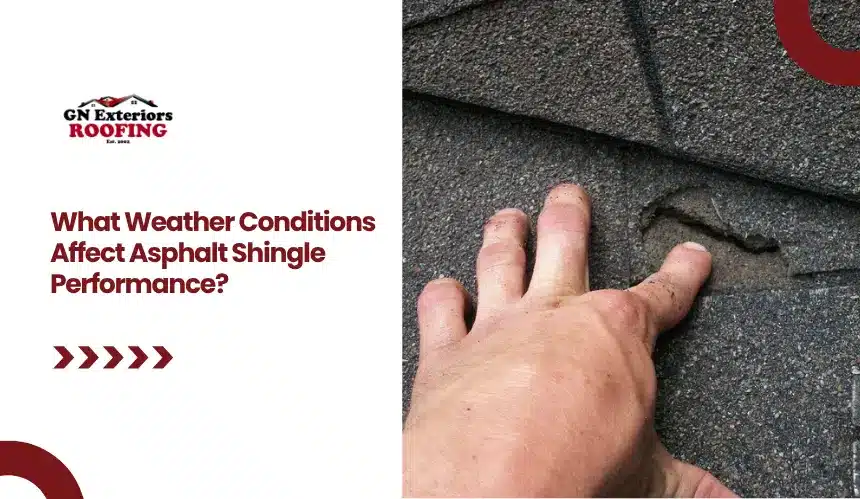
Roof systems built with asphalt shingles are highly sensitive to environmental exposure, yet most performance issues originate from specific weather-driven stress mechanisms rather than material defects. Variations in temperature, moisture levels, wind pressure, and solar radiation directly influence how shingles expand, bond, shed water, and retain structural integrity.
Understanding which weather factors drive these changes is critical for diagnosing premature roof wear and preventing avoidable system failure.
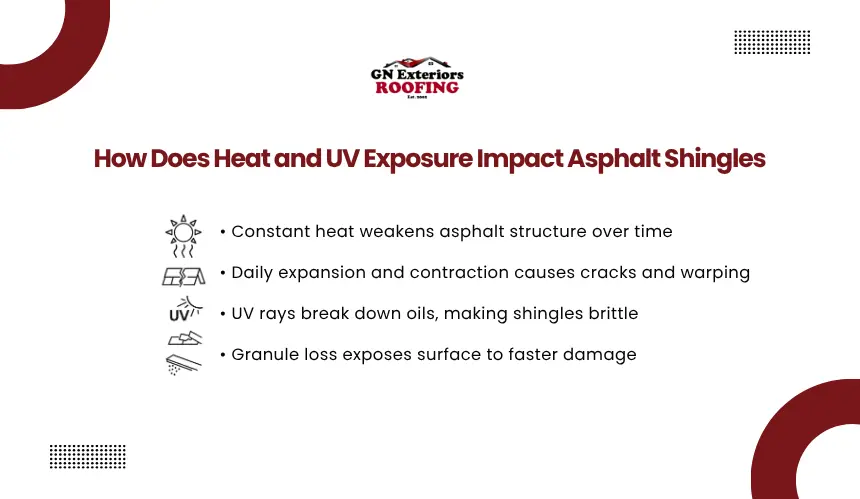
Extended exposure to solar radiation subjects asphalt shingles to continuous thermal stress and chemical breakdown. Elevated surface temperatures, often exceeding ambient air levels by 20–30°C, alter the physical properties of asphalt compounds, weakening structural cohesion and accelerating aging cycles.
Asphalt shingles undergo daily expansion during peak heat and contraction during cooler periods. This repeated movement introduces mechanical fatigue at critical points such as fastener locations and overlapping joints. Over time, this stress leads to micro-fractures, edge curling, and dimensional distortion, reducing the shingle’s ability to maintain a watertight seal.
Ultraviolet radiation initiates photo-oxidation within the asphalt matrix, breaking down hydrocarbon chains and depleting essential oils that maintain flexibility. As these compounds degrade, shingles lose elasticity and become increasingly brittle, making them more susceptible to cracking under minor mechanical loads such as foot traffic or wind uplift.
Protective mineral granules act as a barrier against UV exposure and thermal impact. Prolonged sun exposure weakens the asphalt-granule bond, causing granules to dislodge and expose the underlying bitumen layer. This exposure accelerates heat absorption, intensifies UV damage, and creates a feedback loop that rapidly reduces the functional lifespan of the roofing system.
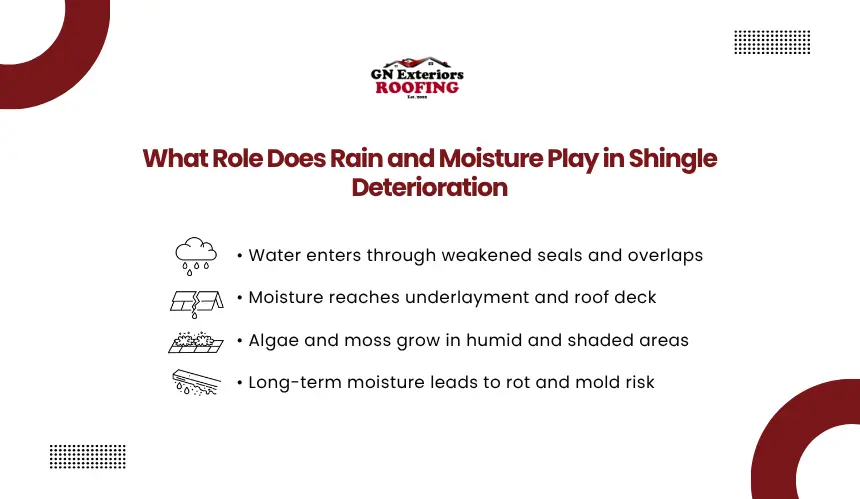
Moisture exposure introduces both surface-level degradation and subsurface structural risks in asphalt roofing systems. Unlike immediate impact damage, water-related deterioration develops progressively, often remaining undetected until underlying components such as decking or underlayment are compromised.
Asphalt shingles rely on adhesive sealant strips to maintain overlap integrity and prevent water ingress. When these seals weaken due to prior thermal stress or aging, wind-driven rain can penetrate beneath the shingle layer.
This is particularly relevant in coastal-influenced areas like Quincy and Weymouth, where nor’easter systems produce sustained wind-driven rainfall that increases lateral water intrusion risk. Once water bypasses the outer layer, it can saturate the underlayment and reach the roof deck, initiating structural decay.
Persistent humidity combined with shaded roof sections creates an environment conducive to biological growth. Algae colonies, particularly Gloeocapsa magma, feed on limestone fillers in shingles, causing dark streaking and surface degradation.
Moss growth introduces a more severe issue by retaining moisture against the shingle surface, preventing proper drying cycles. In inland communities such as Hanover and Randolph, where tree coverage and reduced airflow are common, these conditions are more likely to persist, accelerating surface wear.
When moisture remains trapped beneath shingles due to inadequate ventilation or repeated rainfall cycles, it creates a high-risk environment for wood rot and mold development.
Prolonged saturation weakens the roof deck, reduces nail holding capacity, and compromises load distribution. Over time, this undermines the structural stability of the entire roofing system, often requiring partial or full deck replacement rather than surface-level repairs.
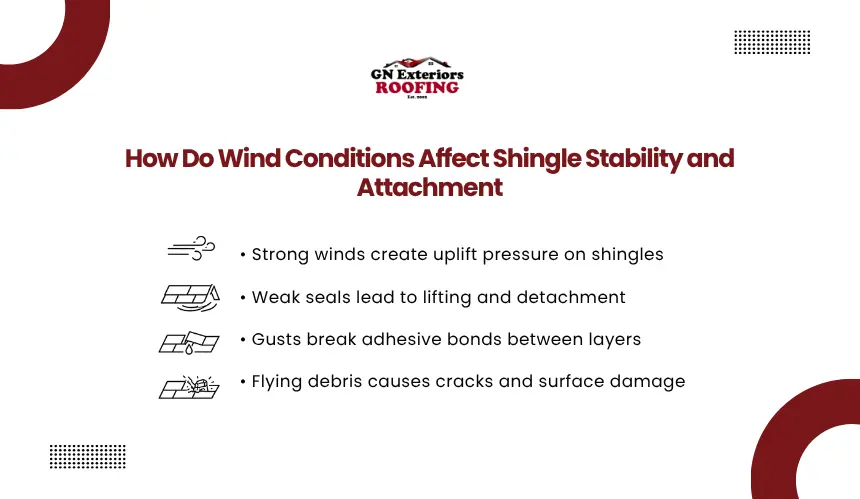
Wind introduces dynamic mechanical forces that directly challenge the attachment strength and sealing integrity of asphalt shingles. Unlike static weather factors, wind creates uplift pressure and lateral movement that can rapidly transition minor vulnerabilities into full system failures.
Wind flowing over a roof surface creates negative pressure zones, particularly along edges, ridges, and corners. This pressure differential generates uplift forces that pull shingles away from the deck. When uplift exceeds the resistance provided by fasteners and sealant strips, shingles begin to lift, crease, or detach entirely, exposing underlying layers to direct weather exposure.
Sealant strips are engineered to bond shingles together under heat activation, forming a continuous barrier against wind intrusion. However, high-velocity gusts can break these bonds, especially if the adhesive has degraded due to age or temperature cycling.
In coastal regions such as South Shore, where seasonal storms and nor’easters generate sustained wind loads, weakened sealants significantly increase the risk of progressive shingle blow-off.
Wind-driven debris introduces localized impact stress that can fracture shingles or dislodge protective granules. Even small debris, when carried at high velocity, can create punctures or surface abrasions that compromise the waterproofing layer.
In suburban areas like Quincy, where mixed residential density and tree coverage are common, airborne debris during storms frequently contributes to cumulative roof surface damage.
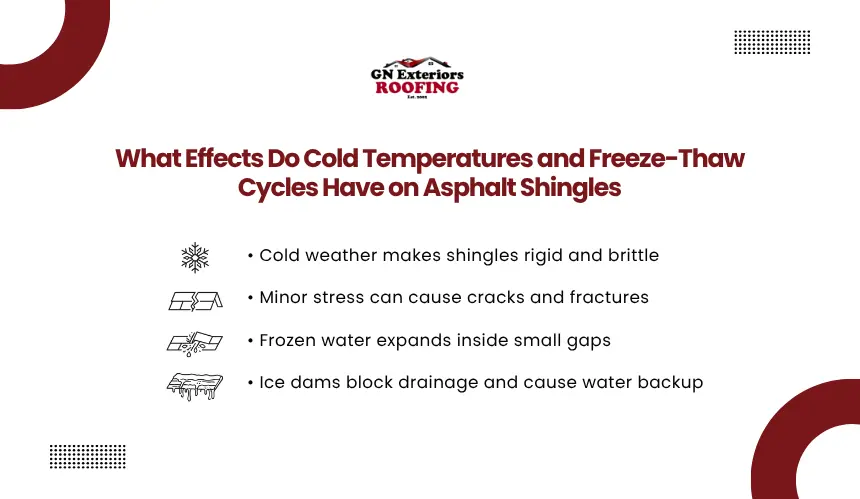
Cold weather alters the physical behavior of asphalt shingles by reducing flexibility and increasing susceptibility to stress-induced damage. When temperatures drop, the material response shifts from pliable to rigid, making the system less capable of absorbing mechanical or environmental strain.
Asphalt compounds lose elasticity at low temperatures, causing shingles to become stiff and prone to cracking under minimal stress. Routine factors such as foot traffic, minor impacts, or wind-induced movement can result in fractures.
This is particularly relevant in inland Massachusetts areas like Randolph, where winter temperature swings expose roofing materials to repeated rigidity cycles.
When water infiltrates beneath shingles or into micro-cracks and subsequently freezes, it expands by approximately 9 percent in volume.
This expansion exerts internal pressure on the surrounding material, widening existing cracks and creating new fracture points. Repeated freeze-thaw cycles progressively weaken the shingle structure and accelerate deterioration at joints and fastener points.
Ice dams form when heat escaping from the attic melts snow on the upper roof, allowing water to flow downward and refreeze at colder eave edges. This creates a barrier that prevents proper drainage, forcing water to back up beneath the shingles.
Once water bypasses the outer layer, it saturates the underlayment and deck, leading to concealed moisture damage that often goes unnoticed until interior leakage appears.
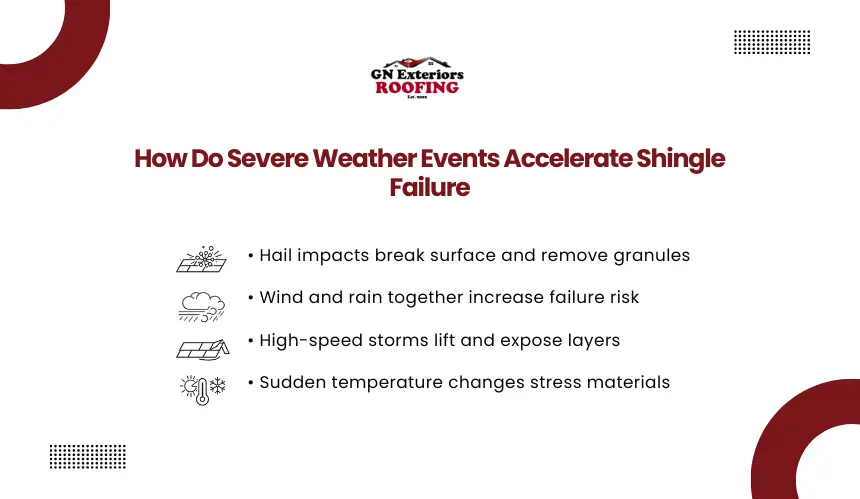
Severe weather events introduce concentrated, high-intensity stress that exceeds the design tolerances of standard asphalt shingles roofing. Unlike gradual wear, these events trigger immediate structural compromise through impact, pressure overload, and rapid environmental shifts.
Hailstones ranging from 1 to 2 inches in diameter can generate impact forces exceeding 20–30 joules per strike, sufficient to fracture the shingle mat or dislodge protective granules. Even when the shingle surface appears intact, bruising beneath the granule layer weakens structural integrity and accelerates future cracking.
As reported by the Insurance Information Institute based on ISO data, Wind and Hail accounted for 42.5% of all homeowners’ insurance losses in 2023, maintaining its position as the largest single cause of property damage claims over the last five years.
Severe storms rarely act through a single variable. Wind speeds exceeding 50–60 mph can lift shingles while simultaneous rainfall increases water penetration risk.
Once uplift occurs, even moderate rainfall can infiltrate beneath the roofing system. This compound effect significantly raises failure probability compared to isolated weather conditions, as structural defenses are compromised in real time.
Rapid drops in atmospheric pressure combined with temperature swings create stress differentials within roofing materials. For example, a temperature shift of 15–20°C within a few hours can induce rapid expansion or contraction, while pressure changes during storm fronts alter uplift dynamics.
These abrupt transitions reduce the material’s ability to adapt gradually, increasing the likelihood of cracking, seal separation, and localized failure zones.
Roof damage rarely starts with a single event. It builds silently through weather exposure until failure becomes unavoidable. GN Exteriors evaluates how environmental stress is actually affecting your shingles and identifies risks before they escalate into costly repairs. If your roof has been through extreme heat, heavy storms, or harsh winters, now is the right time to get clarity on its condition.
A roof should be checked as soon as conditions are safe, especially after hail of 1 inch or more or wind gusts around 58 mph and above, which NOAA uses as severe-thunderstorm thresholds. Early inspection matters because hail bruising, lifted tabs, and seal breaks are often easier to document before additional weather or foot traffic changes the damage pattern.
Not always. Limited, even granule shedding can occur as shingles age, but concentrated bald spots, exposed asphalt, impact bruising, or repeated granule loss in one slope indicate a performance problem rather than normal wear.
The practical threshold is not whether granules are present in a gutter, but whether the protective surface layer is being lost fast enough to expose the shingle mat to UV and moisture.
Yes. Roofers in active Reddit roofing discussions frequently note that shingles can scuff or mark more easily once direct sun heats the surface, even when air temperatures seem manageable.
Heat softens the asphalt layer, so unnecessary foot traffic can displace granules, crease tabs, or leave pressure damage that shortens service life.
They are often caused by algae growth, which may begin as a cosmetic issue but can also signal a roof area that stays damp longer than it should. Persistent surface moisture increases the likelihood of ongoing organic growth and can point to shade, poor drainage, or slow drying conditions that deserve closer evaluation.
Snow accumulation is not always the main failure point. The more serious risk is often the ice dam that forms when meltwater refreezes at the roof edge and forces water back under the shingles. Manufacturer guidance consistently treats ice-dam prevention as a system issue involving ventilation, insulation, drainage, and eave protection, not just the shingle surface alone.