

Massachusetts homeowners are paying closer attention to roofing systems that can support clean energy upgrades while standing strong against New England’s unpredictable weather. This growing shift has made solar-integrated standing seam metal roofs an increasingly appealing choice for residents who want durability and a smooth path toward renewable power.
The combination of a high-performance metal roof with modern photovoltaic technology gives homeowners a chance to invest in a system that supports sustainability, improves energy stability, and aligns with state-level clean energy goals.
This blog will cover how solar-integrated standing seam roofs work, why they are gaining momentum in Massachusetts, and what homeowners should consider when evaluating this roofing and solar combination.
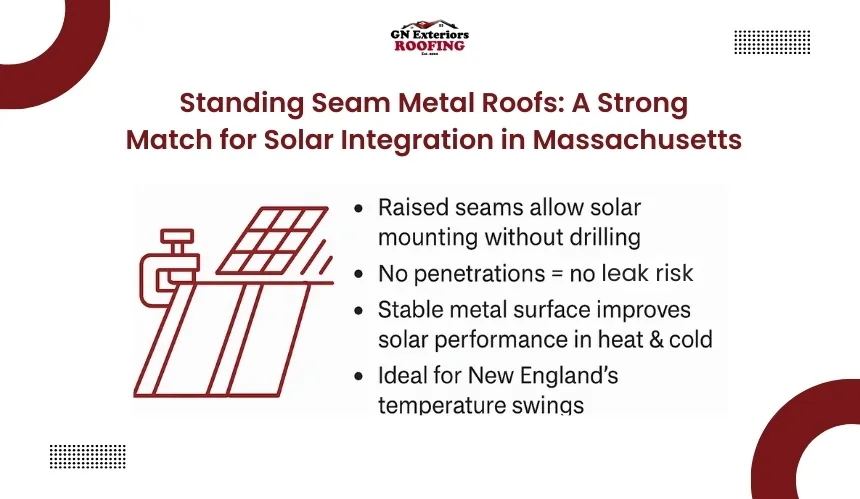
Standing seam panels are engineered with raised vertical seams that create a secure spine for mounting solar equipment. These seams allow solar hardware to attach without drilling, which helps preserve the roof’s weather resistance and reduces the risk of future leaks.
The smooth metal surface also provides a stable temperature profile that supports consistent panel performance during long periods of cold and heat, which is valuable in a state known for significant seasonal variation.
The durability of metal roofing is especially meaningful in regions exposed to snow loads, freeze–thaw cycles, and coastal storms.
Homeowners appreciate that standing seam roofs hold up well under heavy snow, shed precipitation efficiently, and resist corrosion when exposed to ocean air.
These qualities allow families to invest confidently in a roof that supports both long-term protection and modern clean energy upgrades without frequent repairs or structural concerns.
Did you know? Parts of New England experience 50 to 70 freeze–thaw cycles each year, a condition that can accelerate roof deterioration when materials are not structurally resilient |

Standing seam roofing is uniquely designed to accept solar hardware without creating penetrations, making it one of the safest and most efficient platforms for photovoltaic installation in Massachusetts.
Clamp-based attachments lock onto the raised seams of the metal roof using engineered compression that tightly grips the seam without drilling or puncturing the panels.
This no-penetration approach significantly reduces leak risk, maintains the roof’s weather barrier, and avoids the need for caulking or flashing that would typically be required for shingle-based installations.
Because the attachment points connect directly to the seam ribs, the system remains strong during snow loads and high winds, which is especially valuable in Massachusetts’ variable climate.
Standing seam roofs support a wide range of modern solar technologies thanks to their consistent seam spacing, structural stability, and ability to distribute weight evenly.
Monocrystalline modules, microinverter systems, and rail-less installations all perform well on this roofing style because the elevated seams guide placement and improve airflow beneath the panels.
This added ventilation helps regulate panel temperature during summer months, which can support better efficiency and smoother long-term performance across the state’s seasonal weather patterns.

Standing seam metal roofs offer several advantages, such as dependable long-term performance, reduced maintenance, and efficient energy production, giving residents a practical pathway toward reliable photovoltaic installation without compromising roof life or structural integrity.
Because standing seam roofs use clamp-based hardware that does not penetrate the roof surface, manufacturers are more likely to maintain warranty coverage for both the roofing panels and their protective finishes.
This approach minimizes maintenance requirements over the life of the system since there are no fasteners, sealants, or flashing points that can deteriorate with age.
In a region where moisture exposure and yearly freeze–thaw cycles can stress traditional mounts, this installation method supports long-term durability and reduces the likelihood of future repair costs.
Many standing seam metal roofs include reflective pigments that limit heat absorption and help maintain cooler surface temperatures during summer months. Solar panels generally lose efficiency as temperatures rise, so installing them on a cooler, reflective surface supports more consistent energy production.
Massachusetts homeowners benefit from this effect by gaining stronger output during warm seasons and more stable performance across the state’s wide temperature range.
The raised seams on metal roofs act as natural alignment guides for solar installers, helping them design arrays with precise spacing and clean visual lines.
These seams also improve structural stability by giving installers predictable anchor points that support balanced panel distribution.
When seams run in orientations that align well with sunlight exposure, a metal roof installation company can use them to optimize the placement of each panel and improve the overall efficiency of the system without altering the roof structure.
Solar-integrated standing seam metal roofs deliver financial benefits that extend beyond immediate energy savings. They are one of the strongest investment choices for residents seeking predictable returns.
Standing seam metal roofs commonly last 40-70 years, which exceeds the typical life expectancy of asphalt shingles by a wide margin. When paired with solar modules that operate for 25-30 years, homeowners gain a system where the roof outlasts the panels rather than requiring replacement midway through the solar array’s life.
This removes the costly need to detach and reinstall panels for a roof replacement, allowing the full lifespan of the solar system to be used without interruption. This alignment of longevity supports a more predictable payback period and maximizes total energy savings over time.
Solar systems installed on standing seam roofs avoid many of the maintenance issues associated with traditional mounts because no fasteners penetrate the roofing surface. Homeowners spend less on repairs related to flashing deterioration, water leaks, or compromised sealant points.
The metal panels themselves require minimal upkeep, and the clamp-based attachment system remains stable through yearly weather cycles.
This reduced maintenance demand supports long-term cost control and strengthens the return on investment for Massachusetts residents building an energy-efficient home.
Coastal regions in Massachusetts often face harsher environmental conditions compared to inland areas. Salt exposure, high winds, and elevated humidity levels make roofing choices especially important for shoreline communities.
Standing seam metal roofs offer performance advantages that match these conditions, making them one of the most dependable options for coastal homeowners interested in solar installation.
Metal roofing materials used in coastal construction often include corrosion-resistant coatings that protect against salt spray and humid weather. Standing seam profiles are designed to lock tightly into place, which helps them withstand strong wind events common along the Massachusetts shoreline.
This secure interlocking design reduces uplift risks and provides a stable surface for solar attachments. When paired with properly engineered clamp-based mounting systems, the roof can support a solar array that remains stable through seasonal storms and coastal weather fluctuations.
Massachusetts remains one of the strongest states in the country for solar adoption, offering financial programs that help homeowners reduce installation costs and improve long-term savings. These incentives become even more valuable when paired with a standing seam metal roof because the combined system supports longer performance cycles and fewer replacement expenses.
Massachusetts provides several statewide programs that support solar adoption:

Choosing the right standing seam roof involves evaluating material quality, structural considerations, and the mounting hardware that will support the solar array. A thoughtful selection helps ensure both the roofing system and the PV equipment work together efficiently for decades.
The material used for a standing seam roof has a major influence on longevity and solar compatibility. Galvalume is a popular choice due to its corrosion resistance and strong performance in Massachusetts’ coastal and inland climates.
Aluminum panels offer excellent salt resistance, making them ideal for shoreline communities. Specialty coatings can also be added to improve reflectivity, reduce heat absorption, and support stronger solar efficiency.
Evaluating these material differences helps homeowners choose a roof that matches their environment and long-term energy goals.
Before installing solar panels, it is important to confirm that the roof structure can support the combined weight of the panels and mounting hardware. Standing seam roofs typically distribute weight evenly, but homes in Massachusetts must account for additional snow load factors.
A structural assessment helps ensure that the roof framing can handle seasonal snow accumulation along with the solar array. This evaluation protects the home’s safety and ensures the installation complies with local building requirements.
Not all mounting hardware is designed for standing seam roofs, so choosing the correct clamp system is essential. Well-known options such as S-5! clamps and rail-less mounting systems are engineered specifically for raised seams and provide reliable grip without damaging the roofing panels.
The right hardware improves panel alignment, supports long-term stability, and reduces the risk of movement during high winds or winter weather. Working with installers who are experienced in standing seam integration helps ensure the hardware is matched properly to the roof’s profile.

Standing seam metal roofs provide advantages that many other roof types cannot match, especially when durability, weather performance, and solar compatibility are key priorities.
Evaluating how they differ from solar shingles and asphalt shingles helps homeowners choose a system that supports both strong energy production and long-term protection.
Solar shingles offer a clean, integrated appearance, but they typically produce less energy per square foot than traditional solar modules mounted on metal roofs. They may also require full roof replacement, which increases upfront cost.
Standing seam roofs pair with high-efficiency solar panels that can be positioned for optimal sunlight exposure, allowing homeowners to achieve stronger output throughout the year.
The metal roof also lasts significantly longer than the lifespan of solar shingles, which helps avoid replacement cycles that disrupt long-term energy production.
Asphalt shingles remain a common roofing choice, but they require penetrations for mounting solar equipment, which can increase maintenance needs and create potential leak points over time. They also have a shorter lifespan, often making it necessary to replace the roof while the solar panels still have useful life remaining.
Standing seam roofs avoid these challenges through clamp-based attachments and significantly longer durability. The smoother surface maintains more stable temperatures, which can support more consistent solar performance compared to asphalt shingles that absorb and retain heat.
If you’re considering a durable, solar-ready standing seam roof for your home, the team at GN Exteriors is here to help. Our metal roofing specialists understand how to design and install systems that support long-term solar performance while protecting your home in every season.
Yes. Standing seam metal roofs are flexible enough to accommodate future PV advancements such as higher-efficiency modules, upgraded microinverters, and evolving rail-less mounting options. Their structural consistency makes it easy to update solar components without modifying the roof itself, which helps homeowners keep pace with new energy technologies over time.
Homeowners can add snow guards to help control roof shedding in winter. These accessories attach to the standing seams without penetrating the panels, allowing them to work safely alongside solar arrays. Snow management systems can help reduce sudden snow slides while keeping the solar equipment undisturbed.
Standing seam roofs work well with home battery setups because the roof’s stability supports consistent solar generation, which is needed to keep batteries charged. Many Massachusetts homeowners pair their solar arrays with battery storage to help manage peak demand, increase energy resilience, and participate in programs like ConnectedSolutions.
Yes. A solar system installed on a standing seam metal roof can easily support an EV charger as long as the home’s electrical panel is sized appropriately. Many homeowners add EV charging once they realize their solar array generates enough clean power to support daily transportation needs.
Solar panels can help reduce roof noise by creating an additional layer that absorbs some of the impact from rain or hail. Standing seam roofs already offer sound-dampening performance when properly installed, and the presence of a solar array can improve acoustic comfort during storms.
Yes. Because standing seam roofs help maintain stable panel temperatures and reduce mechanical stress on the system, production data from the monitoring platforms is often more consistent. This helps homeowners track energy generation trends more accurately and adjust their consumption habits if desired.