
Selecting the right roofing shingles is not just a design decision; it directly affects durability, maintenance frequency, and long-term cost. Many homeowners choose materials based on price or appearance, only to face premature wear, weather damage, or higher repair cycles.
The challenge lies in balancing performance, climate compatibility, and structural suitability without overspending. This guide provides a clear, decision-focused framework to help identify the most appropriate roofing shingle type based on real-world performance factors.
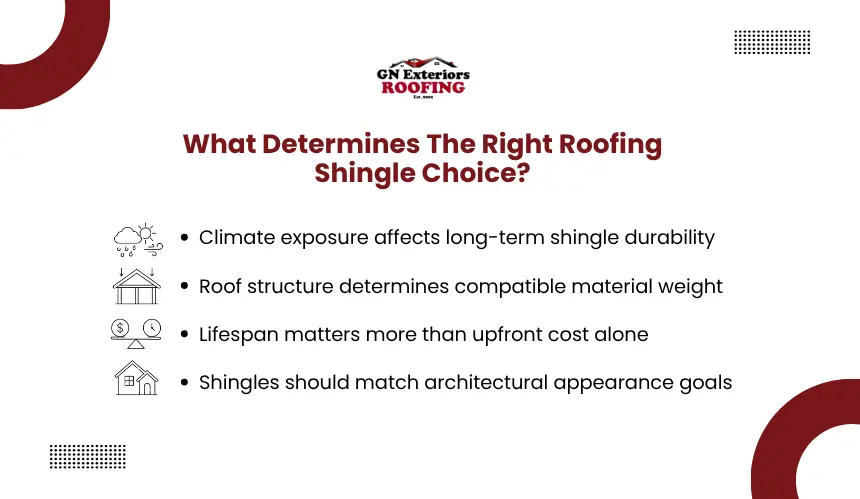
Selecting a roofing shingle type requires evaluating performance conditions rather than comparing surface-level features. The right choice depends on how the material responds to environmental stress, structural constraints, and long-term cost exposure.
Shingle performance is directly tied to local climate patterns. High UV regions accelerate granule loss in asphalt shingles, reducing protective capability over time. In areas with heavy rainfall or snow, moisture resistance and proper water shedding become critical to prevent underlayment damage.
Wind-prone regions require shingles with higher wind uplift ratings to avoid detachment during storms. Selecting a material without aligning it to climate stressors often results in premature degradation and increased repair frequency.
Not all roofing systems are designed to support heavier materials. Slate and some composite shingles place a significant load on the roof deck, requiring reinforced structural framing. Roof pitch also affects material suitability.
Steeper slopes improve drainage and support a wider range of shingles, while low-slope roofs demand materials with superior water resistance. Ignoring structural compatibility can lead to long-term stability issues and costly modifications after installation.
Initial material cost often misrepresents the true financial impact of roofing. Lower-cost shingles may require replacement within 15–20 years, while premium materials extend beyond 40–70 years with minimal intervention.
Evaluating the cost per year of service provides a more accurate financial comparison. Maintenance frequency, repair complexity, and expected lifespan collectively determine long-term value, not just upfront pricing.
Roofing contributes significantly to the visual identity of a property. Shingle type, texture, and color must align with architectural design to maintain consistency and resale value.
For example, dimensional shingles complement modern residential designs, while slate aligns with traditional or high-end structures. Additionally, color stability over time impacts appearance, as some materials fade faster under prolonged sun exposure.
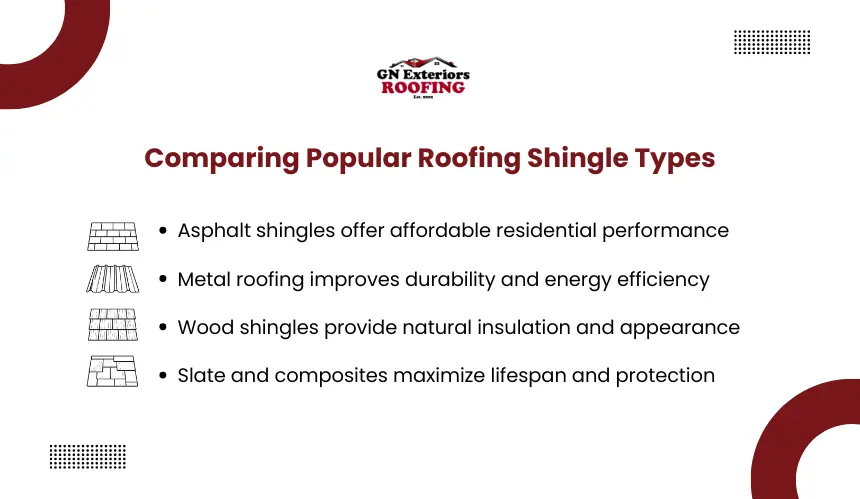
Material selection becomes clearer once the functional differences between shingle types are understood. Each category is engineered with distinct properties that influence durability, energy behavior, and resistance to environmental stress.
Asphalt shingles dominate residential roofing due to cost efficiency and ease of installation. Three-tab shingles use a single-layer design, which limits thickness and reduces wind resistance. Architectural shingles incorporate multiple layers, increasing durability, impact resistance, and dimensional stability.
The added mass improves performance in moderate weather conditions but still exposes them to gradual granule loss under prolonged UV exposure.
Metal shingles are designed for high durability and minimal degradation under extreme conditions. Their reflective surface reduces solar heat absorption, lowering roof surface temperatures and contributing to energy efficiency.
They resist corrosion through protective coatings and maintain structural integrity under high wind and heavy rain. Unlike asphalt, metal does not rely on surface granules, which eliminates a common failure point.
Wood shingles and shakes provide natural insulation due to their density and cellular structure. This helps regulate indoor temperature more effectively than thinner materials.
However, wood is sensitive to moisture absorption, which can lead to expansion, warping, or decay if not properly treated. Fire resistance is also a concern unless the material is chemically treated, making it less suitable for regions with strict fire safety requirements.
Slate shingles offer one of the longest lifespans among roofing materials due to their natural stone composition, which resists weathering, fire, and moisture penetration. Their weight, however, requires reinforced roof structures. Composite shingles replicate the appearance of slate or wood while reducing weight and improving installation flexibility.
Advanced composites also provide impact resistance and consistent performance across varying weather conditions, making them a balanced alternative between cost and durability.
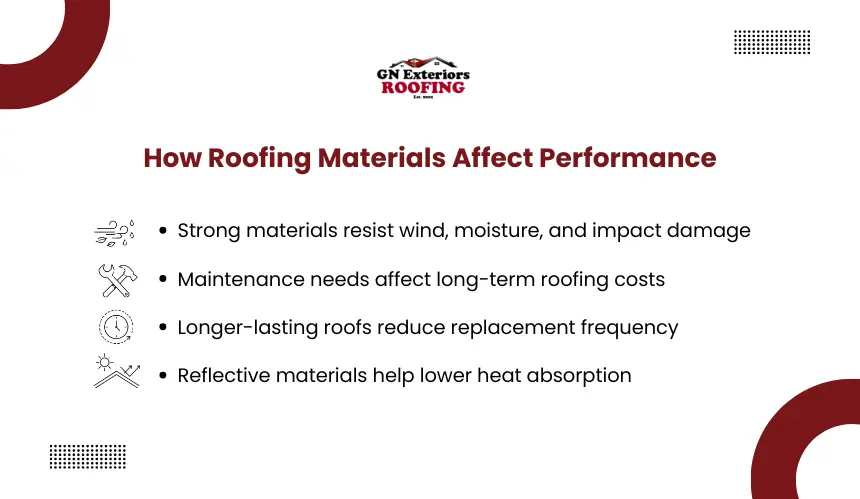
Material selection defines how a roof performs under stress over time. Beyond initial specifications, durability is determined by how well the shingle system resists external forces, how often it requires intervention, and how long it maintains functional integrity.
Durability is largely a function of how shingles respond to wind, moisture, and impact. High wind uplift ratings reduce the risk of shingle displacement during storms, while impact-rated materials minimize damage from hail or debris.
Moisture resistance is critical for preventing water infiltration into the underlayment, which can lead to structural decay. Materials with stable surface composition maintain protective performance longer under continuous exposure.
Different materials demand varying levels of maintenance to retain performance. Asphalt shingles may require periodic inspection for granule loss and localized patching, while wood shingles need ongoing treatment to control moisture absorption and prevent biological growth.
Metal systems typically require less frequent intervention but may involve specialized repair methods if panels are damaged. Maintenance complexity directly influences long-term service costs and downtime.
Lifespan is not solely a material specification but a combination of installation quality, environmental exposure, and maintenance consistency. Asphalt systems generally operate within a 15 to 30-year range under standard conditions. Metal roofing extends significantly longer, often exceeding 40 years with minimal degradation.
Slate systems can last for several decades due to their inherent resistance to environmental breakdown. Choosing a material with a longer operational lifecycle reduces replacement frequency and stabilizes long-term investment.
Material composition influences how a roof manages heat transfer and resource use over its lifecycle. The right shingle can reduce cooling demand, stabilize indoor temperatures, and limit environmental footprint without compromising structural performance.
Surface reflectance determines how much solar radiation is absorbed versus deflected. High-reflectivity coatings and lighter-colored shingles reduce heat gain at the roof surface, lowering attic temperatures and peak cooling loads.
Materials with a higher solar reflectance index maintain performance longer by resisting surface degradation that typically reduces reflectivity over time.
Thermal performance is affected by material density, air gaps, and layering systems. Thicker or multi-layered shingles slow heat transfer, improving indoor temperature stability during extreme conditions.
When combined with proper ventilation and underlayment, certain materials contribute to reduced HVAC cycling, which directly impacts energy consumption patterns.
Environmental impact extends beyond installation to material sourcing and end-of-life disposal. Metal shingles are often manufactured from recycled content and can be fully recycled after use. Some asphalt shingles are repurposed into paving materials, though recycling availability varies by region.
Natural materials such as wood and slate have lower processing footprints but require responsible sourcing to maintain sustainability standards.
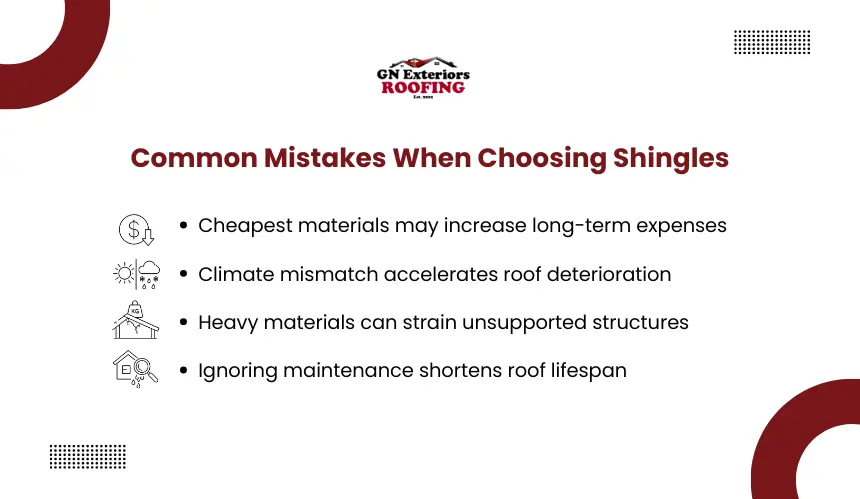
Most roofing failures are linked to incorrect selection decisions rather than installation defects. Avoiding these common mistakes reduces long-term repair cycles and prevents premature material failure.
Final selection should align material performance with how the property is used, the expected ownership timeline, and regional environmental conditions. A structured evaluation reduces the risk of mismatched investment.
Primary residence decisions typically prioritize durability and long-term stability, while rental or short-term ownership may justify lower upfront investment with moderate lifespan materials. Architectural asphalt shingles work well for balanced cost-performance scenarios, while metal or composite options align better with long-term ownership due to reduced replacement cycles.
Decision-making becomes clearer when evaluated through a three-variable lens: initial cost, expected lifespan, and maintenance demand. For example, asphalt offers a lower entry cost but a shorter lifecycle, while metal or composite systems require a higher upfront investment but reduce long-term replacement frequency. The optimal choice depends on whether the priority is cash flow control or lifecycle cost efficiency.
Coastal regions across Massachusetts, including areas like Quincy and Hingham, experience a mix of salt air exposure, high humidity, and strong seasonal storms. Salt accelerates material corrosion, while wind-driven rain increases moisture stress on roofing systems.
Metal shingles with corrosion-resistant coatings perform well in these environments due to their resistance to salt degradation and wind uplift. Architectural asphalt shingles with higher wind ratings also provide reliable performance when properly installed.
Materials sensitive to moisture, such as untreated wood, tend to degrade faster under these conditions and require more frequent maintenance.
Professional input becomes necessary when structural capacity, ventilation design, or local building code compliance is uncertain. A qualified contractor can assess load-bearing limits, recommend climate-appropriate materials, and identify installation factors that influence long-term performance. This reduces the likelihood of costly corrections after installation.
Choosing the right roofing shingles is easier when backed by expert insight and real-world experience. GN Exteriors helps evaluate your roof structure, local conditions, and long-term goals to recommend materials that actually perform. Get clarity before you invest and make a decision that holds up over time.
Compatibility depends on roof pitch, decking condition, ventilation, and load-bearing capacity. A roof with aging sheathing or poor attic airflow may not support heavier materials or high-performance systems properly. A professional inspection can identify whether reinforcement, underlayment upgrades, or ventilation corrections are needed before new shingles are installed.
Architectural shingles often provide better wind resistance, thicker construction, and a longer service life than standard 3-tab shingles. They also create a more dimensional appearance, which can improve curb appeal. For homeowners planning to stay long term, the higher upfront cost usually offers stronger lifecycle value.
Lighter shingle colors generally reflect more sunlight, which can reduce roof surface temperature and help limit attic heat buildup. Darker shingles absorb more heat, which may be useful in colder climates but can increase cooling demand in warmer months. Color should be balanced with insulation, ventilation, and local weather patterns.
Installation quality directly affects wind resistance, water shedding, lifespan, and warranty protection. Poor nail placement, improper flashing, inadequate starter strips, or weak ventilation can shorten the life of even premium shingles. Material quality matters, but correct installation determines whether the roofing system performs as designed.
Homes near coastal or humid regions benefit from shingles with strong moisture resistance, algae protection, and higher wind ratings. Architectural asphalt shingles, coated metal shingles, and quality composite shingles often perform well when installed with proper underlayment and ventilation. Untreated wood usually requires more maintenance in damp environments.
Replacement becomes more practical when damage affects multiple roof sections, shingles are curling or losing granules widely, leaks keep recurring, or the roof is near the end of its expected lifespan. Localized damage can often be repaired, but widespread material failure usually signals reduced system reliability.