
Key Takeaways
|
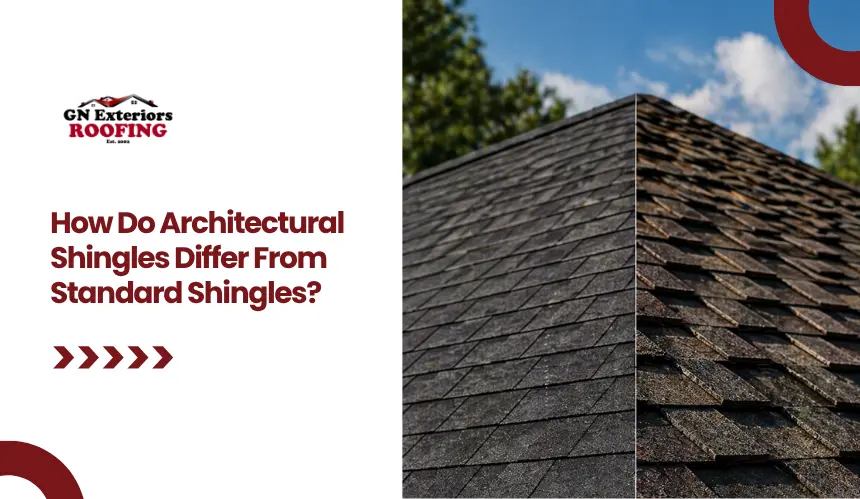
Roofing decisions often come down to material choice, yet many homeowners struggle to understand the real difference between architectural shingles and standard shingles beyond price. A poor selection can lead to premature wear, higher maintenance costs, or reduced protection against weather stress.
Clarity around how these two shingle types perform in real conditions is essential before committing to a roofing system. This article breaks down their structural differences, performance impact, and cost implications to support a more informed decision.
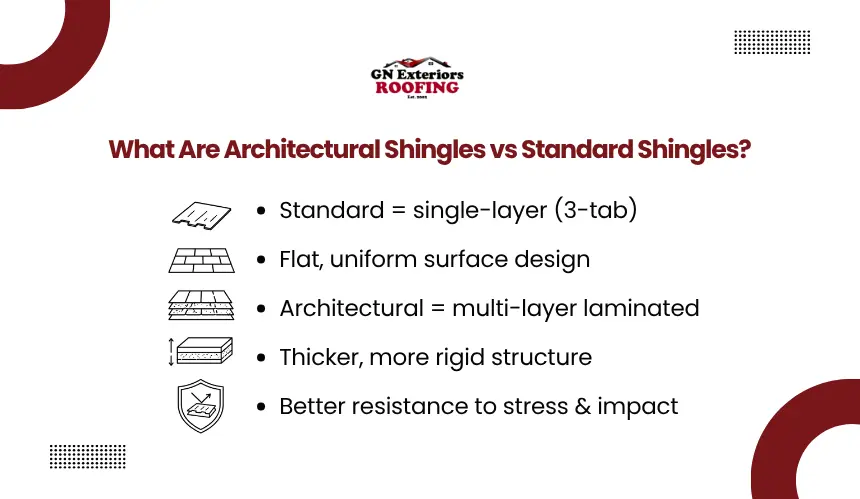
Both shingle types serve the same core function, protecting the roof deck from environmental exposure, but they differ significantly in how they are constructed and how they perform over time. Understanding their base design clarifies why their durability, cost, and visual output vary.
Standard shingles, commonly referred to as 3-tab shingles, are manufactured as a single-layer asphalt sheet with cutouts that create the appearance of three separate tabs. This uniform structure results in a flat profile across the roof surface.
Because the material thickness is consistent throughout, these shingles offer limited resistance to wind uplift and mechanical stress. Their lighter weight reduces material cost and simplifies installation, but it also makes them more susceptible to damage from strong winds, temperature fluctuations, and long-term granule loss.
Architectural shingles are built using a laminated construction, where multiple asphalt layers are bonded together to create a thicker and more rigid unit. This layered design produces a dimensional appearance that replicates higher-end materials such as wood shakes or slate.
The added mass and structural reinforcement improve resistance to wind, impact, and surface deformation. As a result, these shingles maintain their form longer under environmental stress, which directly contributes to extended service life and more stable roof performance over time.
The difference between these shingle types becomes more evident when analyzing how their construction translates into physical behavior and roof aesthetics. Structural design directly influences how the roof handles stress, while visual variation impacts overall property appearance.
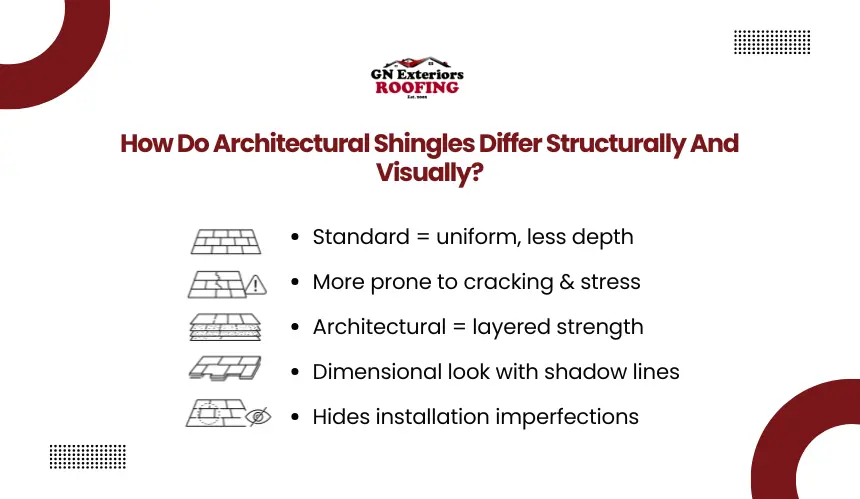
Standard shingles rely on a single asphalt layer reinforced with a fiberglass mat, creating a uniform thickness across each strip. This consistency limits their ability to absorb or distribute stress, making them more vulnerable to cracking under thermal expansion or mechanical impact.
Architectural shingles use a laminated structure where multiple asphalt layers are fused together. This increases overall thickness and introduces internal reinforcement zones, allowing the material to better handle load distribution, resist deformation, and maintain structural integrity under repeated weather cycles.
The flat, repetitive pattern of standard shingles produces a uniform roof surface with minimal visual depth. This consistency can expose alignment imperfections over time and offers limited design flexibility.
Architectural shingles create a staggered, multi-dimensional look due to their layered construction. Variations in tab size and placement generate shadow lines, which enhance depth and reduce the visibility of minor installation inconsistencies. This results in a more refined and visually durable roof profile.
The lighter weight of standard shingles reduces load on the roof structure and allows for faster installation with fewer material handling requirements. However, this also limits their ability to stay anchored under high wind conditions.
Architectural shingles are heavier due to their layered build, which increases both material stability and installation complexity. The added weight improves wind resistance and adhesion performance, but it also requires more precise installation techniques and can increase labor time.
Structural differences directly translate into how each shingle type performs under environmental stress and how long it maintains functional integrity. Performance should be evaluated based on resistance to external forces, degradation patterns, and long-term reliability.
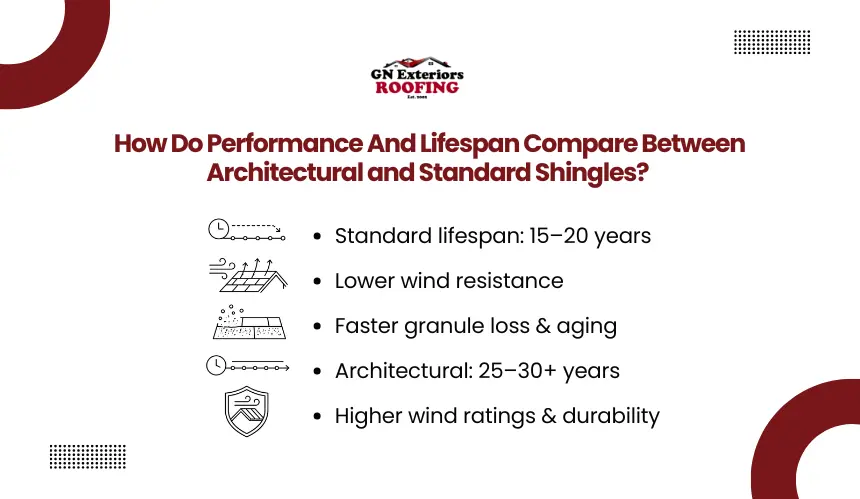
Standard shingles typically carry lower wind resistance ratings because their single-layer design provides fewer bonding points and less surface weight to counter uplift forces. Under strong wind conditions, tabs are more prone to lifting, which can lead to tearing or detachment.
Architectural shingles are engineered with stronger adhesive strips and increased mass, allowing them to achieve higher wind ratings, often in the range of 110 to 130 mph. The layered structure creates better sealing between shingles, reducing the risk of wind-driven water infiltration and blow-off events.
Standard shingles generally have a shorter service life, often around 15 to 20 years, due to faster material fatigue and granule loss. As the protective granule layer wears down, the asphalt becomes more exposed to UV radiation, accelerating deterioration.
Architectural shingles tend to last 25 to 30 years or more because their thicker construction slows down the rate of material breakdown. The layered design also distributes exposure more evenly, reducing localized wear and extending overall roof longevity.
Failure in standard shingles commonly appears as curling edges, cracking, and tab breakage, especially in climates with significant temperature variation. These issues can escalate quickly once the protective surface layer degrades.
Architectural shingles exhibit more stable aging patterns, with lower risk of curling or rapid structural failure. Their resistance to impact and thermal movement reduces the frequency of repairs and lowers the likelihood of premature system-wide deterioration.
Cost evaluation should move beyond upfront pricing and account for how each shingle type performs financially over its full lifecycle. Material pricing, replacement frequency, and downstream impact on property value all influence the true cost.
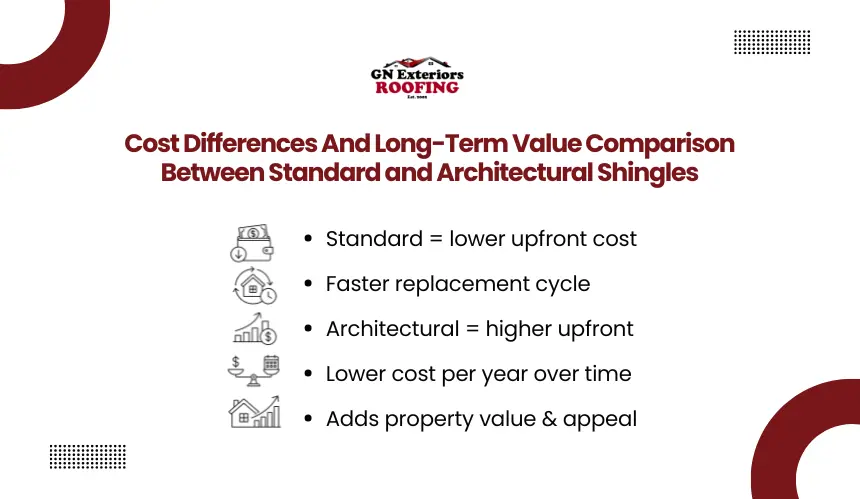
Standard shingles are positioned as a lower-cost option due to simpler manufacturing and reduced material volume. Their lightweight structure also lowers transportation and labor effort, resulting in a more economical installation process.
Architectural shingles require more raw material and involve a more controlled installation process, which increases both material and labor costs. The thicker build demands careful alignment and handling, contributing to higher upfront investment.
A lower initial price does not necessarily translate into lower long-term cost. Standard shingles typically require earlier replacement due to shorter service life, which increases cumulative roofing expenses over time.
Architectural shingles distribute their higher upfront cost across a longer lifespan. When evaluated on a cost-per-year basis, they often provide better value by delaying replacement cycles and reducing the frequency of major roofing work.
Roofing material acts as a visible indicator of overall property condition, especially during inspections and buyer evaluations. Standard shingles fulfill basic functional requirements but are often associated with shorter remaining life expectancy, which can raise concerns during resale negotiations or lead to downward price adjustments if replacement is anticipated.
Architectural shingles contribute more directly to perceived property value because they signal extended durability and reduced near-term maintenance risk. Their dimensional appearance enhances curb appeal, while their longer warranty coverage and higher wind ratings are often noted in inspection reports. This combination can strengthen buyer confidence and, in competitive markets, reduce resistance during valuation discussions.
From an insurance perspective, some carriers factor in roof durability and wind resistance when assessing risk. Architectural shingles that meet higher wind or impact ratings may qualify for policy considerations or minor premium adjustments, particularly in regions exposed to storms or high-wind conditions.
Selection should be based on usage context rather than a general preference. Budget constraints, ownership horizon, and environmental exposure determine which shingle type delivers better outcomes.
Architectural shingles are more appropriate for long-term ownership scenarios where durability and reduced maintenance cycles are priorities. Their structural strength and extended lifespan lower the probability of premature replacement, making them more efficient over time.
They also perform better in environments with higher wind loads or frequent weather fluctuations, where material stability directly impacts roof integrity. For homeowners aiming to maintain property value and minimize long-term disruption, this option provides a more reliable outcome.
Environmental stress plays a decisive role in how roofing materials perform over time, especially in regions with coastal exposure and seasonal temperature swings. In Massachusetts, conditions such as coastal winds, heavy rain, and freeze-thaw cycles place consistent stress on roofing systems.
In areas like Quincy and Weymouth, proximity to the Atlantic increases wind uplift pressure and salt air exposure, which can accelerate material wear in lighter shingles. Architectural shingles offer better resistance in these conditions due to their heavier mass and stronger sealing properties.
Further inland, towns such as Randolph and Milton experience frequent freeze-thaw cycles during winter. These cycles cause expansion and contraction in roofing materials, increasing the risk of cracking and edge curling in standard shingles. The layered construction of architectural shingles provides greater flexibility and structural stability under these repeated stress patterns.
In suburban coastal-transition zones like Hingham and Hanover, where wind, moisture, and seasonal shifts intersect, long-term roof performance depends heavily on material resilience. In these environments, architectural shingles typically maintain integrity longer, while standard shingles may require earlier repair or replacement due to cumulative environmental stress.