
Key Takeaways
|
Selecting the right asphalt shingle is not just about appearance or price. Many homeowners struggle to understand the actual differences between shingle grades, which directly affect durability, weather resistance, and long-term roofing costs.
Clear knowledge of how each grade performs under real conditions is essential for making a cost-effective decision. This guide breaks down the different grades of asphalt shingles and how to evaluate them based on performance, cost, and practical use.
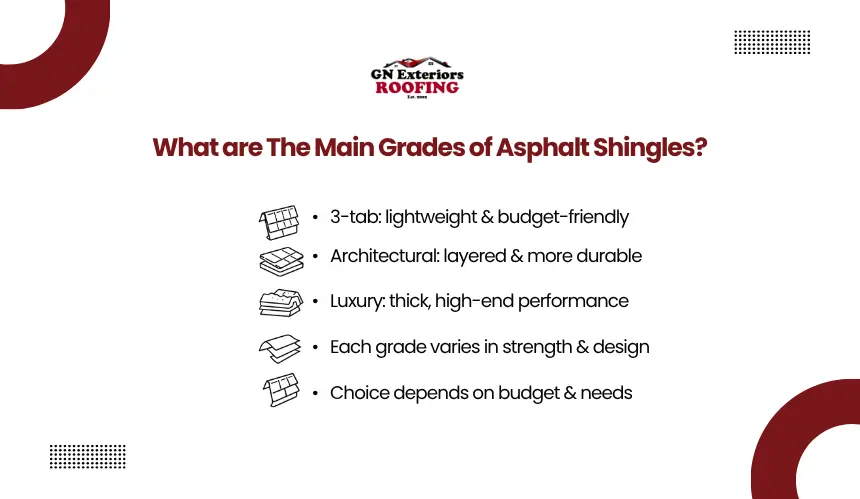
Asphalt shingles are manufactured in three distinct grades, each engineered with different structural properties, cost levels, and performance capabilities. Understanding how these categories are built and where they perform best establishes the baseline for any roofing decision.
3-tab shingles are single-layer products designed with a flat, uniform appearance. Each shingle strip is cut into three tabs, which creates a consistent but minimal dimensional look once installed.
Their lightweight construction reduces material cost and simplifies installation, but it also limits resistance to wind uplift and impact. Typical wind ratings are lower, and the thinner asphalt layer makes them more susceptible to faster granule loss and thermal degradation over time.
These shingles are commonly selected for short-term ownership scenarios, budget-constrained projects, or properties where structural load needs to be minimized.
Architectural shingles use a multi-layered laminate design, where additional asphalt layers are bonded to create thickness and depth. This structure increases overall durability and provides a more textured, dimensional appearance that mimics natural materials.
The added mass improves wind resistance and enhances sealing performance, reducing the likelihood of shingle lift during storms. These shingles also distribute thermal stress more effectively, which slows down aging compared to single-layer options.
They represent a balance between cost and performance, making them the most widely used choice for residential roofing applications.
Luxury shingles are engineered with maximum thickness, advanced material composition, and reinforced backing layers. Their design replicates high-end roofing materials such as slate or cedar shake while maintaining the installation flexibility of asphalt systems.
The increased weight and density significantly improve resistance to wind, impact, and long-term weather exposure. These shingles also maintain structural integrity under temperature fluctuations, reducing cracking and deformation risks.
They are typically selected for high-value properties, long-term ownership plans, or projects where both durability and architectural appearance are primary priorities.
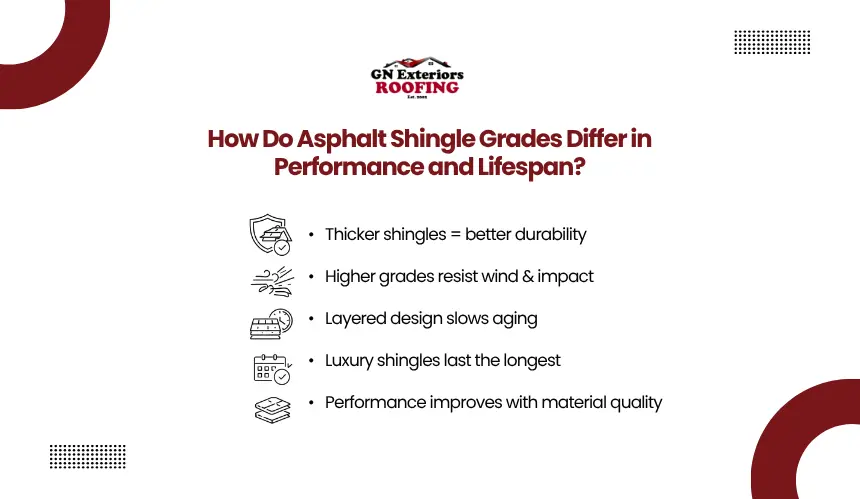
Each shingle grade is engineered with different material density, bonding strength, and structural layering. These variations directly influence how the roof performs under environmental stress and how long it maintains functional integrity.
Wind resistance increases with shingle thickness and sealing capability. 3-tab shingles rely on a basic adhesive strip, which limits their ability to resist uplift under high wind loads.
Architectural shingles use stronger adhesive bonds and heavier construction, allowing them to withstand significantly higher wind speeds without displacement. Luxury shingles go further by combining weight, reinforced backing, and advanced sealants, which improve resistance to both uplift and impact from debris.
In regions exposed to storms or high wind events, these structural differences directly affect failure rates and repair frequency.
Lifespan is primarily determined by material thickness, asphalt quality, and resistance to environmental wear. 3-tab shingles typically have the shortest service life due to faster granule loss and reduced resistance to UV exposure.
Architectural shingles extend lifespan by using layered construction that slows down deterioration and maintains surface protection longer. Luxury shingles achieve the longest lifespan because of their density and enhanced material composition, which reduces breakdown from heat cycles and moisture intrusion.
The difference is not just in years but in how consistently each grade maintains performance over time.
Material composition plays a critical role in durability. Thicker shingles contain more asphalt and higher-quality filler materials, which improve flexibility and resistance to cracking.
3-tab shingles use a thinner asphalt layer, making them more vulnerable to thermal expansion and contraction. Architectural shingles introduce layered reinforcement, which distributes stress across multiple surfaces.
Luxury shingles incorporate advanced composites and heavier mats, increasing structural stability and reducing the risk of deformation under prolonged exposure to heat, cold, and moisture.
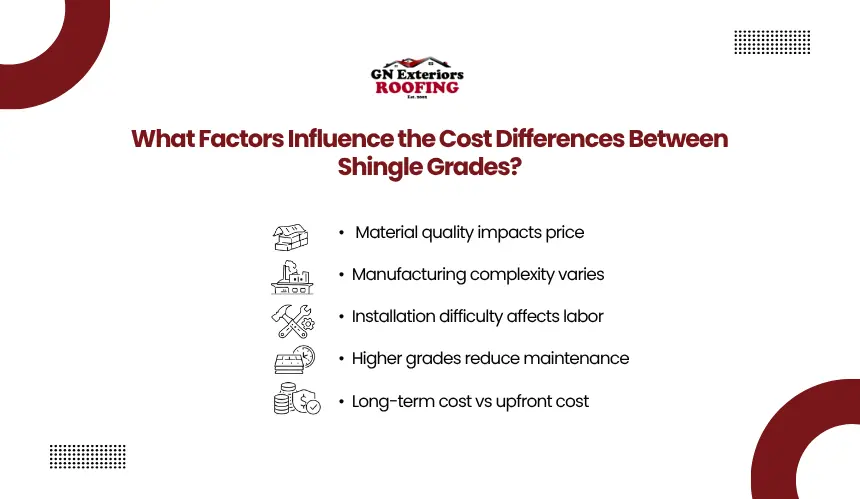
Cost variation across asphalt shingle grades is not arbitrary. It reflects differences in material input, structural complexity, installation demands, and long-term performance outcomes. Evaluating cost without understanding these variables often leads to incorrect value assumptions.
Higher-grade shingles require more asphalt, stronger fiberglass mats, and additional layering processes during production. This increases raw material usage and manufacturing time.
3-tab shingles are produced using a single-layer process with lower material input, which keeps costs minimal. Architectural shingles involve laminated construction, adding both material volume and bonding steps. Luxury shingles incorporate reinforced cores and premium coatings, which significantly raise production cost due to advanced engineering and quality control requirements.
The price difference is directly tied to how much structural strength and durability is built into the product.
Installation complexity increases with shingle weight and design. 3-tab shingles are lightweight and uniform, allowing faster installation with lower labor effort.
Architectural shingles require more precise placement due to their dimensional pattern, which slightly increases installation time. Luxury shingles are heavier and often demand reinforced handling, accurate alignment, and experienced installers to ensure proper load distribution and sealing.
Labor costs rise as installation becomes more technical and time-intensive, especially for premium-grade materials.
Initial cost does not reflect total ownership cost. Lower-grade shingles may require earlier repairs, more frequent replacements, and higher maintenance intervention over time.
Architectural shingles reduce maintenance frequency by offering improved durability and better resistance to environmental wear. Luxury shingles minimize long-term costs further by maintaining structural integrity for extended periods, reducing the need for repairs and premature replacement.
When evaluated over the full lifecycle, higher-grade shingles often deliver lower cost per year of service despite higher upfront investment.
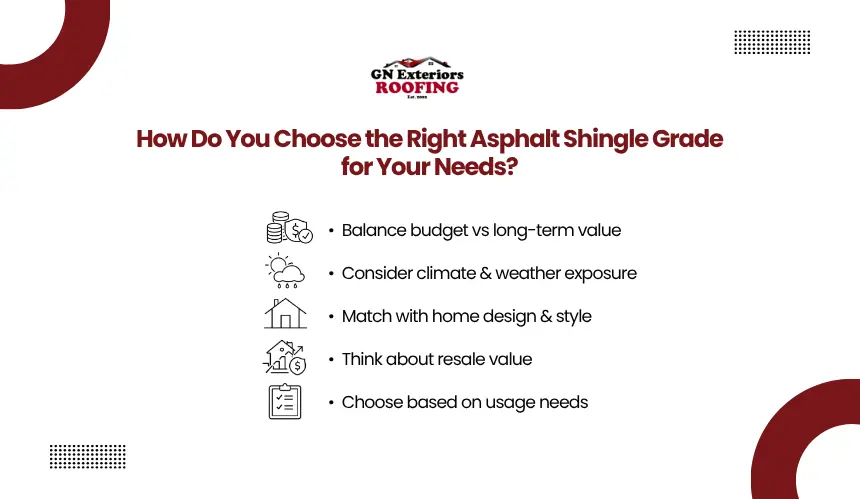
Selecting the appropriate shingle grade requires aligning product performance with environmental exposure, ownership timeline, and financial priorities. The goal is not to choose the highest grade, but the one that delivers the most stable performance under real operating conditions.
Lower upfront cost often leads to higher lifecycle cost when durability is limited. 3-tab shingles reduce initial spending but increase the likelihood of earlier replacement and ongoing maintenance.
Architectural shingles provide a more stable cost-to-performance ratio by extending service life without a significant jump in installation cost. Luxury shingles shift the focus toward long-term capital efficiency, where higher initial investment reduces future repair cycles and replacement frequency.
The decision depends on whether the property is viewed as a short-term asset or a long-term investment.
Coastal and storm-exposed areas require higher resistance to wind, moisture, and salt air. In locations like Quincy and Hingham, where proximity to the Atlantic increases salt exposure, shingles face accelerated granule erosion and material fatigue.
Architectural and luxury shingles perform better in these conditions due to stronger sealing strips and thicker asphalt layers. In inland areas such as Randolph, where temperature fluctuations and seasonal freeze-thaw cycles are more pronounced, material flexibility becomes critical to prevent cracking and surface stress damage.
Selecting a grade without accounting for these localized environmental factors can significantly shorten roof lifespan.
Shingle grade influences not only durability but also how the roof integrates with the home’s architectural profile. Properties in areas like Milton and Hingham often feature traditional or coastal designs where dimensional depth and texture enhance curb appeal.
Architectural shingles provide a layered appearance that aligns with most residential styles, while luxury shingles replicate high-end materials such as slate, which is commonly seen in older or higher-value homes across Greater Boston.
For homeowners considering resale, higher-grade shingles can improve perceived property value by signaling durability and reduced future maintenance requirements.
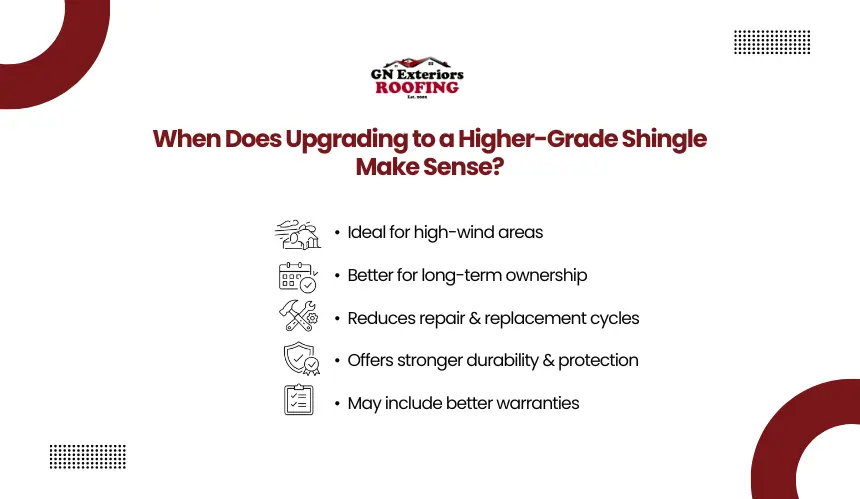
Upgrading to a higher-grade shingle is not always necessary, but in specific conditions, it delivers measurable performance and financial advantages. The decision depends on exposure risk, ownership horizon, and the cost of potential failure.
In areas exposed to coastal storms or strong seasonal winds, higher-grade shingles provide critical structural stability. Along the South Shore, including Weymouth and Hingham, wind uplift and driving rain place continuous stress on roofing systems.
Architectural shingles offer stronger adhesive bonding and improved wind ratings, while luxury shingles add mass and reinforced backing that reduce the risk of shingle displacement and edge lifting. This directly lowers the probability of storm-related damage and emergency repairs.
Ownership duration significantly affects return on investment. For short-term ownership, lower-grade shingles may meet functional requirements without overcommitting capital.
For long-term ownership, higher-grade shingles reduce cumulative costs by extending replacement cycles and minimizing maintenance interventions. Architectural shingles provide a balanced upgrade, while luxury shingles are better suited for properties intended to be held for decades without major roofing reinvestment.
Higher-grade shingles often qualify for enhanced manufacturer warranties due to their structural reliability and material quality. This includes longer coverage periods and better protection against defects and performance degradation.
In some cases, insurers recognize improved impact resistance and wind performance, which can influence coverage terms or claim outcomes after severe weather events. While not universal, this added layer of protection becomes relevant in regions where weather-related roof damage is a recurring risk.
Choosing the right shingle grade is not just about roofing, it is about protecting long-term property value and avoiding avoidable repair cycles. GN Exteriors evaluates real-world conditions across Greater Boston and the South Shore to recommend roofing systems that match performance demands, not just budgets.
Architectural shingles are widely treated as the standard for residential roofing because they offer stronger wind resistance, thicker construction, and longer service life compared to 3-tab products. Their laminated design improves sealing performance and durability, making them a more reliable baseline for long-term roofing systems rather than an upgrade.
Class 4 refers to an impact-resistance rating, not a style tier. A shingle can be architectural or premium and still carry a Class 4 rating if it is engineered to better withstand hail and wind-blown debris. That matters for storm-prone areas because impact resistance and product grade solve related but different performance questions.
In shorter ownership timelines, the decision depends on resale positioning and local environmental exposure. Architectural shingles typically provide the best balance by improving visual appeal and durability without excessive upfront cost. Premium shingles may only deliver added value if the property competes in a higher-end housing segment.
Yes. Roofs with valleys, dormers, hips, and multiple slope transitions place more stress on alignment, sealing, and water shedding. On a complex roof, a thicker laminated product often provides a better visual finish and more forgiving performance margin than a thinner strip shingle, especially where wind-driven rain or uplift can exploit weak points.
Insurance savings are possible, but they are usually tied to specific performance features such as Class 4 impact resistance rather than the marketing label “premium” or “luxury.” Manufacturer guidance notes that Class 3 and especially Class 4 products may qualify for discounts in some markets, but the actual benefit depends on carrier rules and local risk models.
It can be. Mixing grades may create visible texture differences, uneven weathering patterns, and inconsistent wind performance across roof sections. It can also complicate warranty expectations if the installed products do not match the system assumptions for the full roof. For repair work, homeowners often prioritize compatibility before upgrading appearance alone.