
Key Takeaways:
|
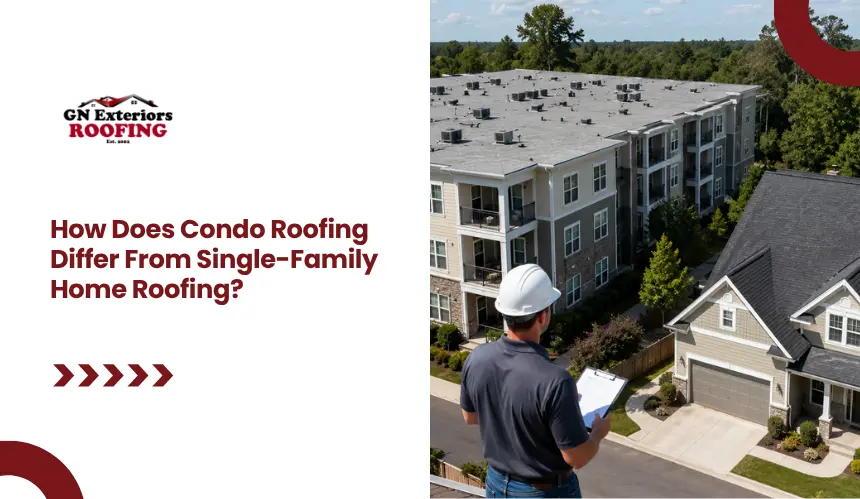
Roofing decisions become more complex when the property type changes, especially between condos and single-family homes. Many buyers and property owners assume roofing works the same across both, which leads to confusion around responsibility, costs, and long-term control.
In reality, the differences are structural, legal, and operational, directly affecting maintenance timelines, financial planning, and decision authority. This article breaks down how condo roofing and single-family home roofing differ across structure, ownership, maintenance, and cost implications.
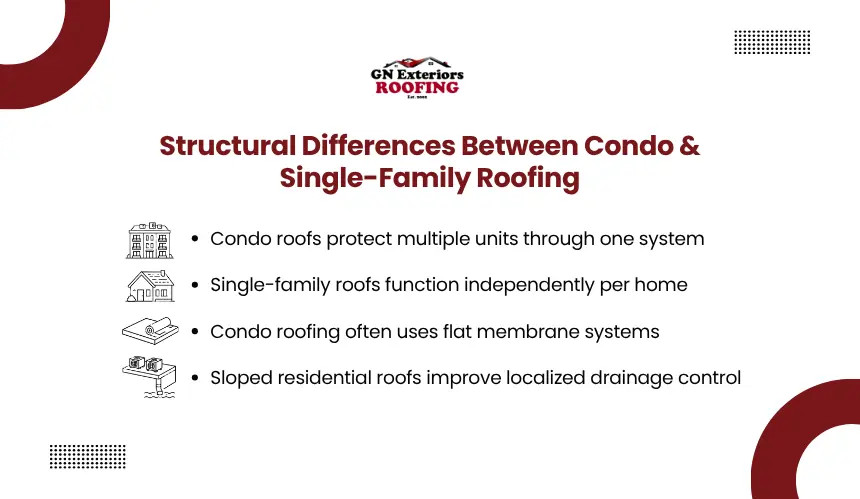
Condo roofing is built as a single, shared system that protects multiple units within one structure, while single-family roofing is designed as an independent system for one home. This difference directly affects how damage spreads, how repairs are handled, and how the roof performs under stress.
Condo roofs are typically larger and often flat or low-sloped to support multi-unit layouts, HVAC systems, and complex drainage. Because the system is continuous, issues like leaks or membrane failure can impact multiple units at once. In contrast, single-family homes use smaller, sloped roofs that improve water runoff and isolate problems to one property.
Material selection also follows this structural difference. Condo roofing uses membrane-based systems like TPO or EPDM for large, flat surfaces, while single-family homes rely on shingles, tiles, or metal suited for sloped designs, making repairs more localized and easier to manage.
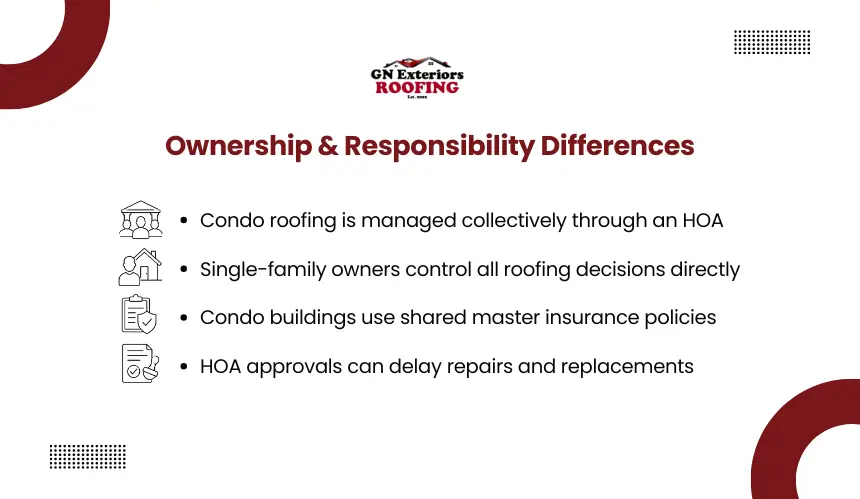
Condo roofing is managed and owned collectively through an HOA, while single-family roofing is fully owned and controlled by the individual homeowner. This difference directly impacts decision authority, insurance structure, and financial responsibility.
In condo properties, the roof is typically owned and managed by the homeowners’ association. Maintenance, inspections, and replacements are handled collectively, meaning individual unit owners do not directly control roofing actions.
For single-family homes, the homeowner has full ownership of the roof. All decisions related to maintenance, repair, or replacement are made independently, with no shared oversight.
Condo roofing is usually covered under a master insurance policy held by the HOA, which protects the building structure. However, coverage limits and exclusions can vary, and unit owners may still need separate policies for interior damage.
Single-family homeowners carry their own insurance for the entire structure, including the roof. This creates a direct relationship between damage, claims, and financial recovery without shared policy layers.
In condo settings, roofing decisions require coordination through the HOA, often involving approvals, budgeting cycles, and contractor selection processes. This can delay action but ensures standardized maintenance across the building.
Single-family homeowners can act immediately when issues arise. Contractor selection, repair scope, and timing are fully controlled by the property owner, allowing faster response but requiring individual responsibility for quality and cost.
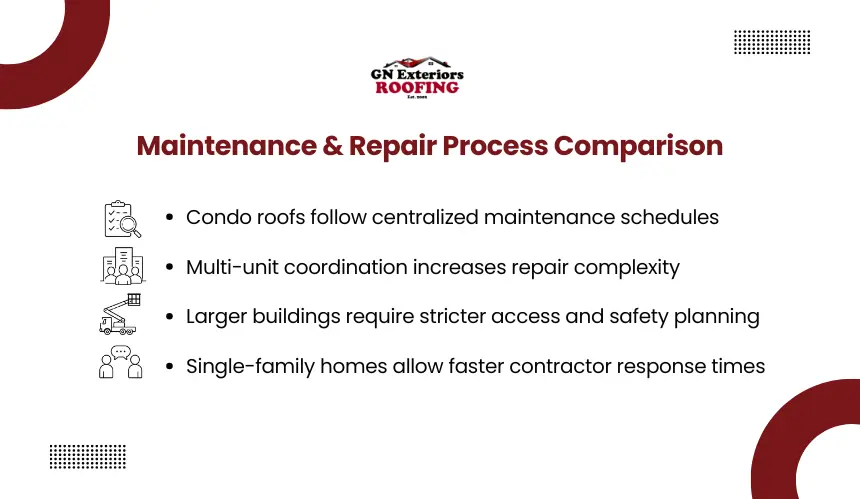
Condo roofing follows a planned, centralized maintenance model managed by an HOA, while single-family roofing relies on owner-driven, on-demand maintenance. This difference affects response time, coordination complexity, and how efficiently issues are resolved.
Condo roofs are typically maintained through scheduled inspections and preventive maintenance plans set by the HOA. Regular servicing helps identify issues early, but actions depend on budget cycles and approval processes.
Single-family homeowners usually follow a reactive model, addressing problems when visible signs like leaks or damage appear. Preventive maintenance depends entirely on the owner’s awareness and planning.
Maintenance in condo buildings requires coordination across multiple stakeholders, including property managers, board members, and contractors. Repairs must consider the impact on multiple units, which can delay execution and increase planning requirements.
In single-family homes, coordination is minimal. The homeowner works directly with a contractor, allowing quicker scheduling and simplified communication.
Condo roofing often involves restricted access due to building height, shared spaces, and safety regulations. Contractors may need specialized equipment and must follow strict access protocols, increasing time and cost.
Single-family homes offer easier roof access with fewer restrictions. This allows faster inspections and repairs, reducing labor complexity and overall project duration.
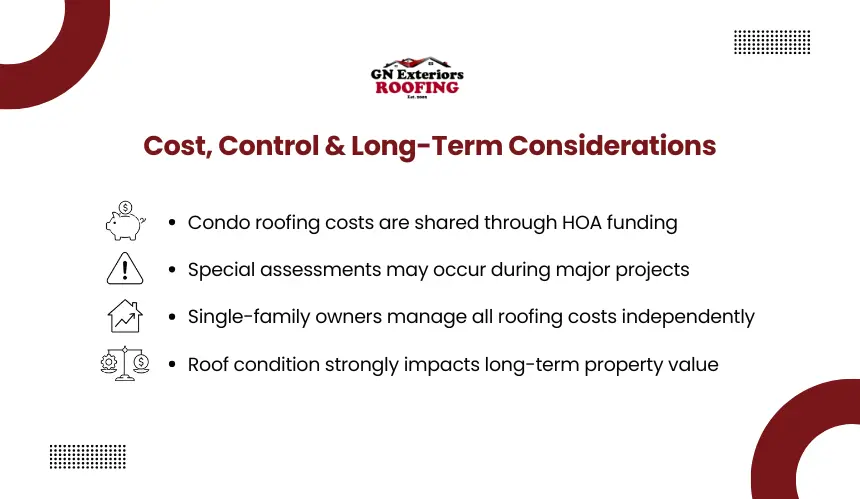
Condo roofing costs are shared and managed through HOA fees and reserve funds, while single-family roofing costs are paid directly by the homeowner. This changes how expenses are planned, distributed, and experienced over time.
In condo properties, roofing expenses are typically covered through monthly HOA fees and long-term reserve funds. These funds are allocated for major repairs or full roof replacements, reducing the need for immediate large payments.
In single-family homes, homeowners pay for roofing costs directly. Repairs and replacements require upfront budgeting or financing, making costs more immediate and individually managed.
If HOA reserves are insufficient, condo owners may face special assessments, where each unit contributes a portion of the roofing cost. These charges are distributed but can still be significant depending on the project size.
Single-family homeowners face the full cost of unexpected roofing issues. A major repair or replacement becomes a single financial burden rather than a shared expense.
Condo roofing spreads costs across multiple owners, creating predictable contributions but limiting individual control over spending decisions. Financial planning is tied to HOA management and collective priorities.
Single-family roofing gives full financial control to the homeowner. While this allows flexibility in timing and material choices, it also requires disciplined budgeting to handle large, infrequent expenses.
The choice comes down to control, financial exposure, and how much responsibility the owner is willing to manage. Condo roofing reduces direct involvement but limits decision control, while single-family roofing offers full control with higher individual responsibility.
Condo roofing operates under shared control through an HOA, which standardizes decisions but removes individual authority over timing, materials, and contractors. This suits owners who prefer less involvement in structural maintenance.
Single-family roofing gives full control to the homeowner. Every decision, from inspection frequency to replacement materials, is made independently, allowing customization but requiring active management.
In condo properties, roof condition is tied to overall building maintenance. Buyers evaluate HOA management quality, reserve funds, and past maintenance records, as these directly affect long-term reliability.
For single-family homes, the roof is a standalone asset. A well-maintained or recently replaced roof can increase resale value and reduce buyer concerns, while visible deterioration can directly impact negotiations.
Condo roofing spreads risk across multiple owners, but response timelines depend on HOA processes, which can delay urgent repairs. Owners trade speed for structured management.
Single-family roofing places all risk on the homeowner, but allows immediate action. Repairs can be scheduled without external approval, making it easier to address issues quickly and prevent further damage.
In regions across Massachusetts, including Quincy, Randolph, and Weymouth, seasonal conditions like heavy snow loads and freeze-thaw cycles increase stress on roofing systems.
Condo properties typically rely on HOA-managed inspections to handle these climate-driven risks, while single-family homeowners must proactively monitor drainage, insulation, and structural wear to prevent long-term damage.
Roofing decisions impact long-term cost, control, and property value more than most owners expect. If you need clarity before making a repair or replacement decision, GN Exteriors can help you evaluate the right approach based on your property type. Get expert guidance that aligns with your structure, budget, and long-term goals.
Responsibility usually depends on the condo association documents, master insurance policy, and the cause of the leak. The HOA may handle roof repair if the roof is a common element, while the unit owner’s policy may cover interior finishes, furniture, or personal property damaged by water intrusion.
A condo owner usually cannot replace an individual roof section without HOA approval because the roof is typically treated as a shared structural component. Even if the leak appears above one unit, repairs must align with building-wide standards, warranty requirements, contractor access rules, and association maintenance policies.
Buyers should review the HOA reserve study, recent roof inspection reports, maintenance records, insurance coverage, and meeting minutes discussing roofing issues. These documents reveal whether the association has planned for replacement costs or if owners may face special assessments after purchase.
Condo roofing is often more complicated because it involves shared ownership, board approvals, multi-unit risk, access planning, and larger roof systems. Single-family roofing is usually simpler because one owner controls the repair schedule, contractor choice, budget, and material decisions without association-level coordination.
In a condo sale, buyers often evaluate both roof condition and HOA management strength. Poor reserve funding or unresolved leaks can reduce confidence even if the unit looks well-maintained. For single-family homes, roof age and visible condition directly influence inspection results, negotiation leverage, and buyer financing concerns.
Massachusetts weather can expose roofing weaknesses through snow load, ice dams, wind-driven rain, and freeze-thaw movement. In communities like Quincy, Randolph, and Weymouth, condo owners depend on HOA maintenance planning, while single-family homeowners must monitor gutters, attic ventilation, flashing, and shingles more directly.