
Key Takeaways
|
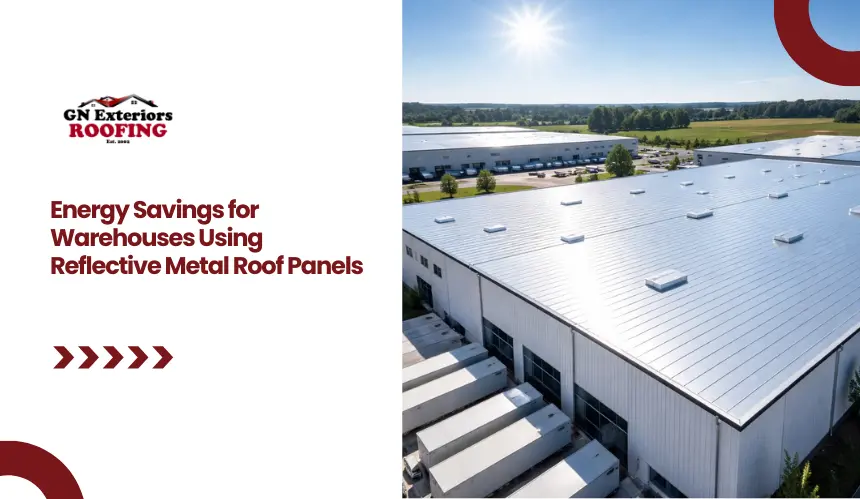
Warehouses consume significant energy due to large roof surfaces, expansive interior volumes, and continuous lighting or climate control needs.
Many industrial buildings struggle with excessive heat gain through roofing systems, especially in regions with high solar exposure. Reflective metal roof panels are increasingly used to reduce heat absorption, stabilize indoor temperatures, and improve overall building efficiency.
This article explains how reflective metal roofing contributes to warehouse energy savings, how the technology works, and what facility managers should evaluate when considering this roofing solution.
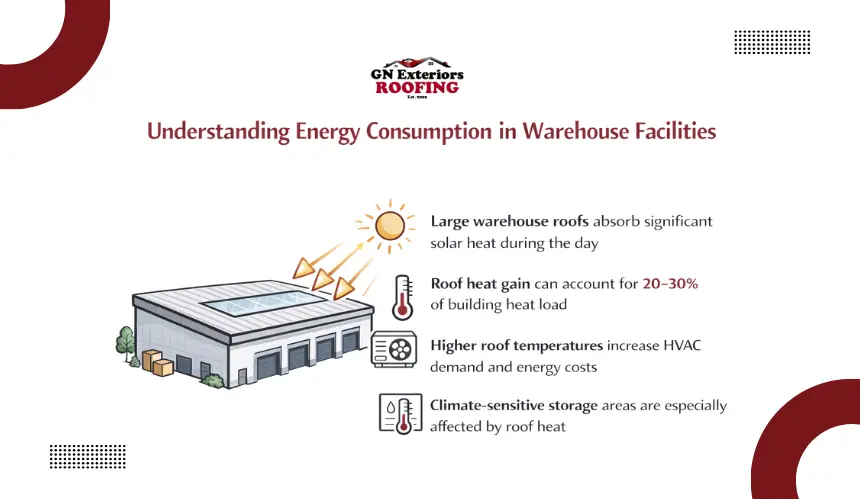
Warehouse facilities operate with large roof spans, minimal interior partitions, and significant internal air volumes. Because of this structural design, roofing systems play a major role in overall building energy performance.
According to the U.S. Department of Energy, roofs can account for 20–30% of total heat gain in large commercial buildings, particularly in structures with limited attic space or thermal buffering layers.
In distribution centers, logistics hubs, and manufacturing warehouses, solar exposure on the roof directly influences indoor temperatures. When roofing materials absorb large amounts of solar radiation, heat gradually transfers into the building interior. This process increases cooling demand, raises operational energy costs, and places additional strain on mechanical systems responsible for temperature control.
Facilities that operate with climate-sensitive inventory, such as food storage, electronics, or pharmaceutical products, are especially affected by roof-driven heat loads. Even in warehouses that rely primarily on ventilation rather than full HVAC systems, roof heat gain can significantly influence indoor working conditions and equipment performance.
Solar radiation striking a roof surface can elevate roof temperatures far beyond ambient air temperatures. ORNL research has shown that while the ambient air might only be 90°F, dark roof surfaces can easily reach 150°F to 190°F because they absorb up to 90% of solar energy.
This heat transfer influences energy consumption in several measurable ways:
For facilities that operate continuously, these thermal loads accumulate throughout the day. Over time, repeated heat absorption from the roof contributes to elevated annual energy consumption across the entire facility.
Warehouses typically feature roof areas that exceed 50,000 to several hundred thousand square feet, particularly in modern distribution centers supporting e-commerce or large logistics operations. Because of this scale, even small increases in roof surface temperature can translate into substantial heat gain across the building envelope.
Several architectural and operational factors amplify this effect:
Temperature stratification further intensifies the problem. Warm air rising toward the ceiling creates a thermal layer beneath the roof deck, increasing the amount of heat retained within the building. In large warehouses, this stratification can lead to ceiling-level temperatures that are 15–20°F higher than floor-level temperatures during peak summer conditions.
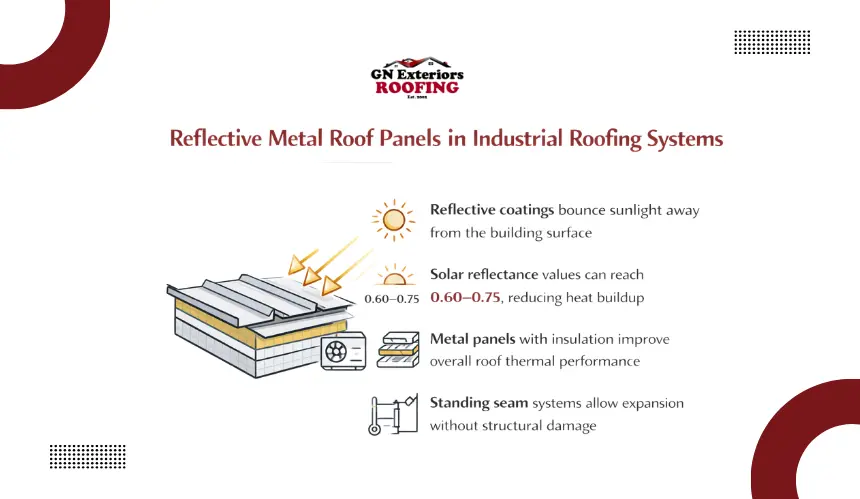
Reflective metal roof panels are engineered roofing components designed to reduce solar heat absorption and improve the thermal performance of large commercial buildings. In warehouse environments, where roof surfaces often exceed tens of thousands of square feet, the choice of roofing material can significantly influence building energy consumption.
Modern reflective metal roofing systems use specialized coatings and surface finishes that reflect a substantial portion of incoming solar radiation.
Solar reflectance measures the percentage of sunlight a roof surface reflects away from the building. Traditional dark roofing materials often have reflectance values between 0.05 and 0.20, meaning most solar energy is absorbed as heat. Reflective metal roofing systems can achieve solar reflectance values around 0.60–0.75, reducing heat buildup on the roof surface.
By reducing heat buildup on the roof, these systems help stabilize indoor temperatures, lower cooling demand, and improve the overall efficiency of warehouse operations.
Reflective metal roofing systems used in warehouses are typically designed as integrated assemblies rather than standalone panels. Each component contributes to durability, weather protection, and thermal performance.
A typical system includes several key elements:
Standing seam metal roofing systems are widely used in warehouse construction because they allow panels to expand and contract with temperature changes without compromising structural integrity. This design helps extend roof lifespan while maintaining consistent reflective performance.
Two performance metrics determine how effectively a roof reduces heat buildup: solar reflectance and thermal emittance.
Solar reflectance measures how much incoming sunlight a roofing surface reflects back into the atmosphere. Traditional dark roofing materials often have reflectance values as low as 0.05 to 0.20, meaning they absorb the majority of solar energy. Reflective metal roofing systems, by contrast, can reflect several times more solar radiation.
Thermal emittance refers to the ability of a material to release absorbed heat. Roofing materials with high emissivity can radiate heat away more quickly once solar exposure decreases.
Together, these properties influence the Solar Reflectance Index (SRI), a widely used metric in building energy design. High-performance cool metal roofs can achieve SRI values above 80, while conventional roofing materials often fall below 20.
Solar reflectance measures the percentage of sunlight a roof surface reflects away from the building. According to the U.S. Department of Energy, white roofing materials can reflect approximately 60–90% of incoming sunlight, allowing significantly less solar energy to be absorbed as heat.
For warehouse facilities operating in warm climates or high-sun regions, roofing systems with strong solar reflectance and thermal emittance properties can significantly reduce roof surface temperatures.
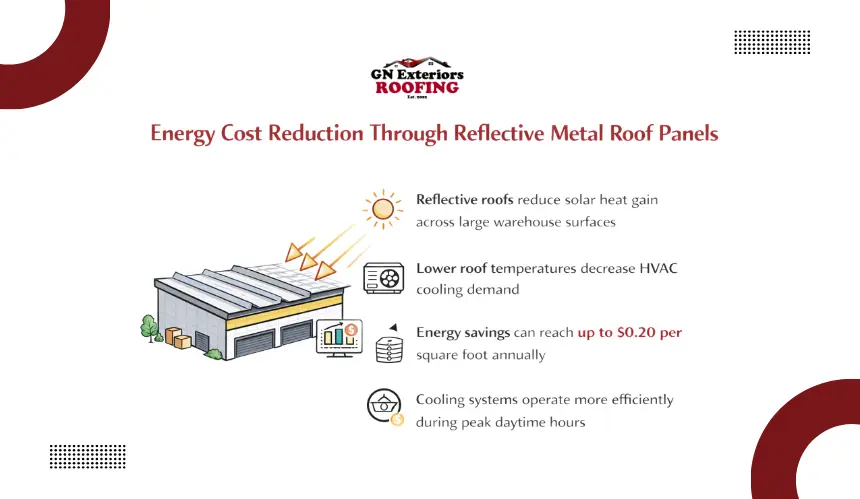
Reflective metal roof panels reduce cooling costs by limiting solar heat gain at the roof surface. The U.S. Department of Energy states that cool roofs reflect more sunlight and absorb less solar energy, which lowers building temperatures and reduces air-conditioning demand. DOE also notes that, in hot climates, cool roofs deliver the greatest cooling savings.
For large warehouse buildings, the cost impact can be meaningful because roof area is extensive and cooling loads are often concentrated during peak daytime hours.
A DOE fact sheet reports that installing a white roof on a commercial building can produce annual energy savings worth up to $0.20 per square foot, with results varying by climate and building conditions.
Oak Ridge National Laboratory also confirms that cool-roof cost savings should be evaluated at the whole-building level and provides its Roof Savings Calculator for estimating annual energy and cost savings based on roof type, insulation, climate, and building use.
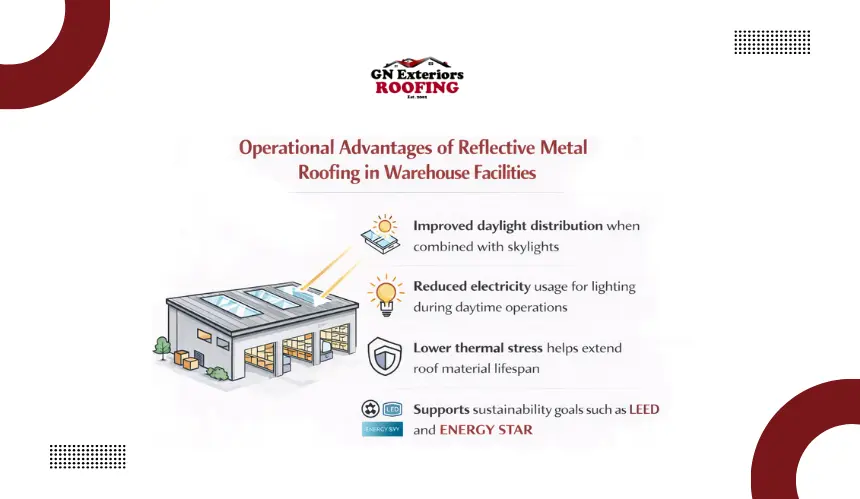
Reflective metal roof panels provide operational benefits that extend beyond direct energy savings. By reducing roof surface temperatures and limiting solar heat gain, these roofing systems influence several aspects of warehouse performance, including lighting efficiency, building durability, and environmental sustainability.
In large logistics facilities where operational uptime, infrastructure lifespan, and energy management are closely monitored, roofing systems that improve overall building performance can contribute to measurable long-term value.
Warehouse lighting systems account for a significant portion of electricity consumption in industrial buildings. According to the U.S. Energy Information Administration (EIA), lighting accounted for 10% of total energy consumption in U.S. commercial buildings in 2018.
Reflective roofing materials can contribute to improved lighting conditions inside warehouses by increasing the reflectivity of the roof structure and supporting daylighting strategies.
When combined with skylights or translucent roof panels, reflective roof surfaces help distribute natural light more evenly across large floor areas.
Operational advantages include:
These improvements are particularly relevant in large distribution centers where lighting systems operate for extended hours.
Roofing systems exposed to prolonged solar radiation experience continuous cycles of heating and cooling. Over time, this thermal expansion and contraction can accelerate material fatigue and coating degradation.
Lower roof temperatures can contribute to longer service life for metal roofing systems by reducing the intensity of daily thermal cycling.
Operational implications include:
Extending roof lifespan can reduce long-term facility maintenance costs, particularly in warehouses where roof replacement projects involve large surface areas.
For warehouse operators focused on sustainability targets or energy efficiency certifications, reflective roofing may contribute toward building performance standards such as:
By lowering building heat absorption and supporting energy efficiency strategies, reflective metal roof panels help warehouse facilities align operational performance with modern sustainability objectives.
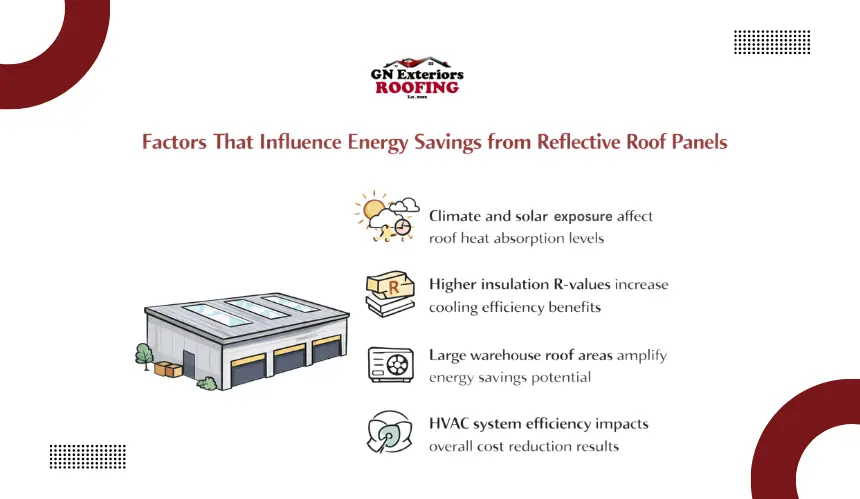
The level of energy savings achieved with reflective metal roof panels varies depending on building design, climate conditions, and operational characteristics. Energy modeling tools used in commercial building analysis show that several structural and environmental variables determine the magnitude of cooling savings.
Key factors include:
Implementing reflective metal roofing requires careful evaluation of the existing building structure, roofing materials, and operational requirements. Proper planning ensures that metal roof installation delivers consistent performance over its service life.
Important considerations include:
Improving warehouse energy efficiency often starts with the right roofing system. GN Exteriors specializes in high-performance metal roofing solutions designed to reduce heat gain and support long-term building performance in Massachusetts.
Reflective metal roofing systems are known for long service lives when properly installed and maintained. Industry data indicates that many metal roof systems can last 40 to 60 years in commercial applications. The life span can increase significantly with proper maintenance.
Protective coatings and corrosion-resistant metals such as galvanized steel or aluminum help maintain structural integrity over extended operational periods.
Yes. Metal roofing systems are often considered compatible with commercial solar installations because standing seam designs allow solar mounting brackets to attach without penetrating the roof surface. Metal roofs can provide a durable base for photovoltaic systems, allowing building owners to combine roofing upgrades with renewable energy generation.
Metal roofing systems used in industrial buildings are engineered to withstand high wind loads, heavy rainfall, and hail impacts. Research shows that properly installed metal roofs can achieve wind resistance ratings exceeding 140 mph, making them suitable for large commercial structures in many regions.
Reflective metal roofing systems can be designed to accommodate industrial ventilation equipment such as ridge vents, turbine ventilators, and mechanical exhaust units. Properly integrated ventilation systems help regulate airflow within large warehouse interiors and support overall building performance without compromising roof durability.
Most metal roofing materials used in commercial buildings are highly recyclable. The Metal Roofing Alliance reports that metal roofs typically contain 25–95% recycled content and are 100% recyclable at the end of their service life. This characteristic makes metal roofing a resource-efficient option compared with many conventional roofing materials.